France’s point-of-sale (POS) ecosystem in 2026 is one of the most fragmented and localised in Europe. Unlike markets dominated by a handful of global vendors, French merchants rely heavily on domestic solutions tailored to local regulations, fiscalisation requirements, payment habits, and sector-specific workflows. For software vendors, this means a single global POS integration is rarely sufficient to achieve meaningful automation.
The scale of the opportunity is significant. France operates more than three million payment terminals, and forecasts suggest roughly 2.1 million dedicated POS devices by 2028. The environment is dense, card-centric, and populated by specialised platforms across beauty, hospitality, retail, and quick-service dining.
To deliver reliable transaction data, automate back-office processes, and provide real-time analytics, SaaS and fintech products must integrate directly with the POS systems French merchants actually use. In this guide, we’ll explore nine of the most important France-focused POS APIs and highlight the technical factors that matter when planning integrations.
Planity: Beauty & wellness POS API
Planity is the leading beauty and wellness booking and POS platform for hairdressers, barbers and salons in France, with an integrated cash register and Stripe‑powered payments. Founded in 2017, it now serves over 35,000 salons and eight million monthly users across Europe, growing payment volume by about 200% while enabling new revenue streams.
- Data model: Appointments, services, staff calendars, clients, tickets, deposits, and payment transactions.
- API/auth: REST endpoints combined with Stripe APIs; OAuth or API keys typically provisioned through partner connectors such as Chift.
- Sync model: Near real‑time push of bookings/payments; incremental reconciliation.
- Use cases: Loyalty/churn analytics, revenue dashboards, accounting exports.
Read more about it: Planity API Integration Guide
Lightspeed: Global REST API with strong French footprint
Lightspeed Retail POS is a cloud‑based POS and e‑commerce platform with strong adoption in French retail and hospitality chains, offering inventory, CRM, and omnichannel tools. It powers multi‑store operations and recently enhanced its API for better European compliance, making it a go‑to for scaling merchants.
- Data model: Items, categories, customers, orders, payments, taxes, locations, inventory.
- API/auth: REST API (JSON/XML), OAuth2, developer portal with sandbox environments.
- Sync model: Webhooks + polling for real‑time order/inventory replication.
- Use cases: Omnichannel inventory, financial reconciliation, CRM integrations.
Read more about it: Lightspeed API Integration Guide
Zelty: Multisite restaurant POS built on iPad
Zelty is a French iPad‑based POS tailored for restaurants, supporting multi‑site operations, online ordering, delivery, and kitchen displays. Launched in 2021, it’s recognised by France Num for digitalisation, helping restaurateurs streamline FOH/BOH amid rising delivery demand.
- Data model: Orders, tables, menus, modifiers, delivery flows, kitchen statuses.
- API/auth: REST endpoints; API keys via connectors.
- Sync model: Bi‑directional order sync; periodic menu/stock updates.
- Use cases: Delivery aggregation, multi‑site reporting, operations dashboards
Read more about it: Zelty API Integration Guide
L’Addition: iPad POS for restaurants and bars
L’Addition is a veteran French iPad POS for HoReCa, certified LNE‑compliant for anti‑fraud laws, with table management, mobile ordering, and integrated payments including titles‑restaurants. It supports 10,000+ venues and integrates seamlessly with UberEats/Deliverect for omnichannel workflows.
- Data model: Tickets, line items, discounts, taxes, payments, stock.
- API/auth: REST/JSON via connectors; API keys.
- Sync model: Incremental ticket/stock sync; hourly batches.
- Use cases: Loyalty tools, multi‑store dashboards, ERP exports.
Read more about it: Zelty API Integration Guide
Popina: iPad POS for omni‑channel retail and restaurants
Popina is an iPad‑based POS solution used by French cafés, bars, restaurants, and food trucks, featuring quick order splitting, assisted Z‑reports, and peripheral support. It’s praised for simplicity and speed, ideal for high‑volume SMBs in fast casual.
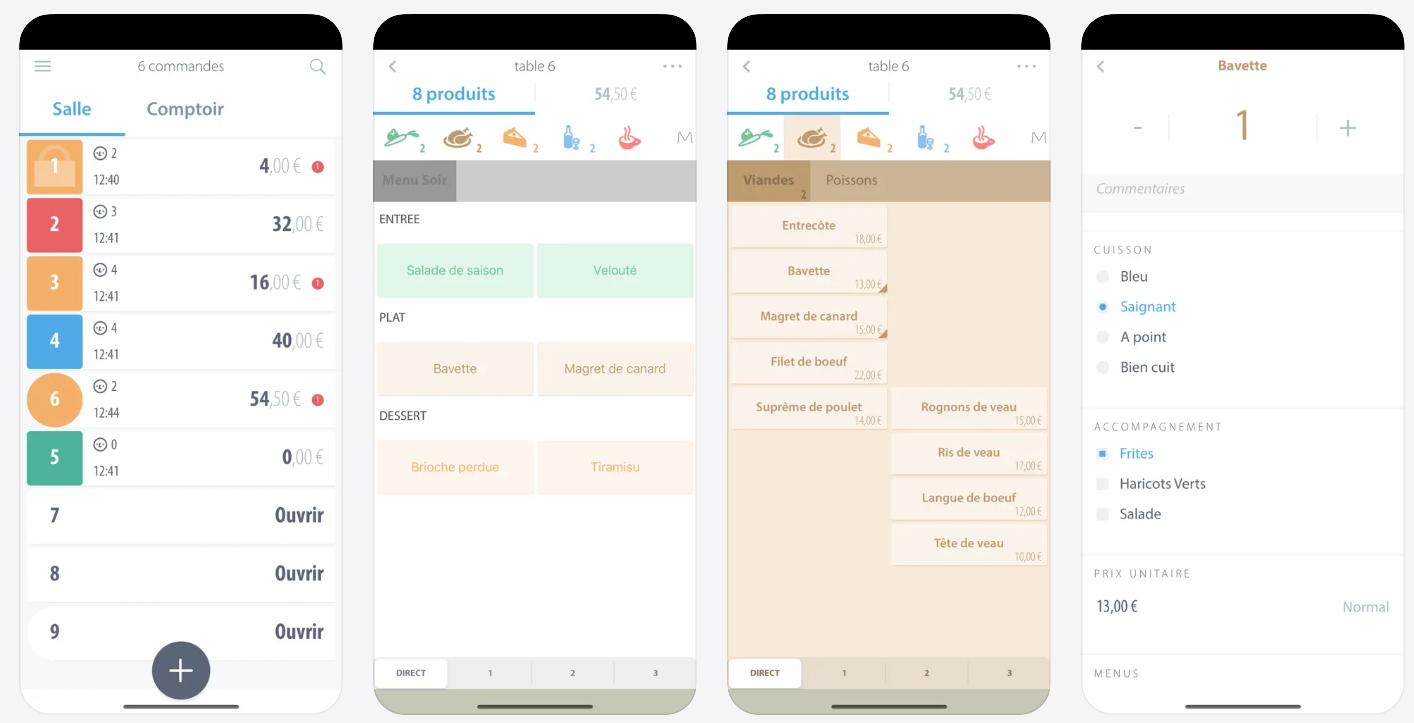
- Data model: Tickets, line items, discounts, taxes, payments, stock.
- API/auth: REST/JSON via connectors; API keys.
- Sync model: Incremental ticket/stock sync; hourly batches.
- Use cases: Loyalty tools, multi‑store dashboards, ERP exports.
Related: Popina API Integration Guide
Hiboutik: Online POS for small and mid‑sized retailers
Hiboutik is an online POS that helps French businesses manage sales operations, inventory, customer data and finances from the cloud. It is popular among independent retailers and SMBs looking for low‑friction web‑based POS.
- Data model: Tickets, catalogue, stock movements, customers, cash reports.
- API/auth: HTTP/REST with tokens; cloud backend.
- Sync model: Polling for tickets/stock; scheduled exports..
- Use cases: Retail analytics, e‑com stock sync, BI feeds.
Related: Hiboutik API Integration Guide
Cashpad: Hospitality‑oriented POS with financial workflows
Cashpad is positioned as a POS and management solution for hospitality businesses in France, and is often used alongside accounting workflows. It focuses on making small businesses more efficient by streamlining their financial operations.
- Feature set: Cash register, invoicing, expenses, payment tracking and core financial management.
- Integrable data: Sales, invoices, payment methods, tax lines, and expense items, which can feed accounting or spend‑management tools.
- Integration concerns: Batch vs real‑time syncing, payment reconciliation, and aligning Cashpad categories with external GL or product structures.
- Use cases: Automating daily hospitality takings into accounting, building revenue analytics, and integrating POS data into cash‑flow forecasting tools.
Related: Cashpad API Integration Guide
Innovorder: End‑to‑end restaurant operations suite
Innovorder offers a suite covering the five main “stress points” of restaurant owners: order taking, payment, preparation, loyalty and customer management. It serves 51–200 staff chains with €44–66M valuation. It targets France’s fast‑casual growth amid delivery boom. For food‑tech, delivery, or operations platforms, Innovorder’s API unlocks a full picture of restaurant flows.
- Data model: Orders, items, payments, customers, prep status, loyalty.
- API/auth: RESTful; role‑based credentials.
- Sync model: Real‑time bi‑directional; batch BI exports.
- Use cases: Channel aggregation, pricing, loyalty campaigns.
Related: Innovorder API Integration Guide
Jalia: iPad cash register by JDC SA
Jalia is an iPad‑based cash register published by JDC SA with more than 300 features and connected accessories, tailored to French merchants. It is designed to be easy to use, modern, and well connected to peripheral hardware.
- Hardware integration: Supports connected peripherals like receipt printers, scanners, and payment terminals alongside the iPad app.
- API surface: Cash register tickets, product catalogue, discounts, taxes and device metadata, enabling full POS event capture.
- Integration considerations: Handling multi‑device environments and ensuring that each ticket is uniquely identified across registers and days.
- Use cases: Real‑time sales dashboards across Jalia and other POS, centralised master catalogue, and automated fiscal exports.
Related : Jalia API Integration Guide
How to Choose the right French POS APIs for 2026
When prioritising French POS integrations, technical and product teams should consider:
- Vertical fit: Ensure the POS matches your target sector (beauty, restaurant, retail). Planity and Hiboutik serve very different merchant needs.
- API maturity: Look for REST/JSON support, OAuth2, webhooks, and reliable documentation.
- Coverage: Access to detailed data beyond sales- items, taxes, staff, tips, loyalty.
- Scale and traction: Prioritise widely adopted tools like Planity, L’Addition, Zelty, and Innovorder.
If you plan to scale across France and other European countries, maintaining nine separate POS integrations, each with its own versioning, rate limits, and fiscal nuances, quickly becomes a maintenance burden. This is why many teams adopt a unified POS API layer that normalises data models, abstracts authentication, and centralises monitoring, while still giving access to local champions
Chift’s Unified POS API connects to leading French systems, reducing development effort while ensuring reliable, up-to-date connectivity. It also provides normalised data models, centralised monitoring, and ongoing connector maintenance, so your team can scale faster without managing each integration individually. Connect to know more.
FAQs
1. What data should I prioritise when integrating a POS API?
At minimum, prioritise tickets, line items, taxes, discounts, payment methods, and timestamps; for advanced use cases, add customers, staff, and loyalty events.
2. Are these POS APIs standardised across providers?
No. Each provider uses its own schemas, authentication methods and rate limits, so you need custom mappings and integration logic per tool.
3. How often should I sync POS data?
For reporting and reconciliation, near‑real‑time or frequent incremental syncs are ideal; batch nightly exports may suffice for low‑frequency accounting or compliance workflows.retail-support.
4. How can I reduce maintenance across all these French POS integrations?
Many SaaS and fintech teams connect once to a unified POS API offered by a specialist integration platform, which then handles individual connectors, normalisation, and monitoring for systems like Planity, Zelty, L’Addition, Popina, Hiboutik, Cashpad, Innovorder and Jalia.
.webp)

.jpg)