For a software vendor, an integration is never a one-off project. It's a building block you have to build, maintain, monitor, and keep evolving, week after week, month after month. And all that time is time that doesn't go into the core of your product.
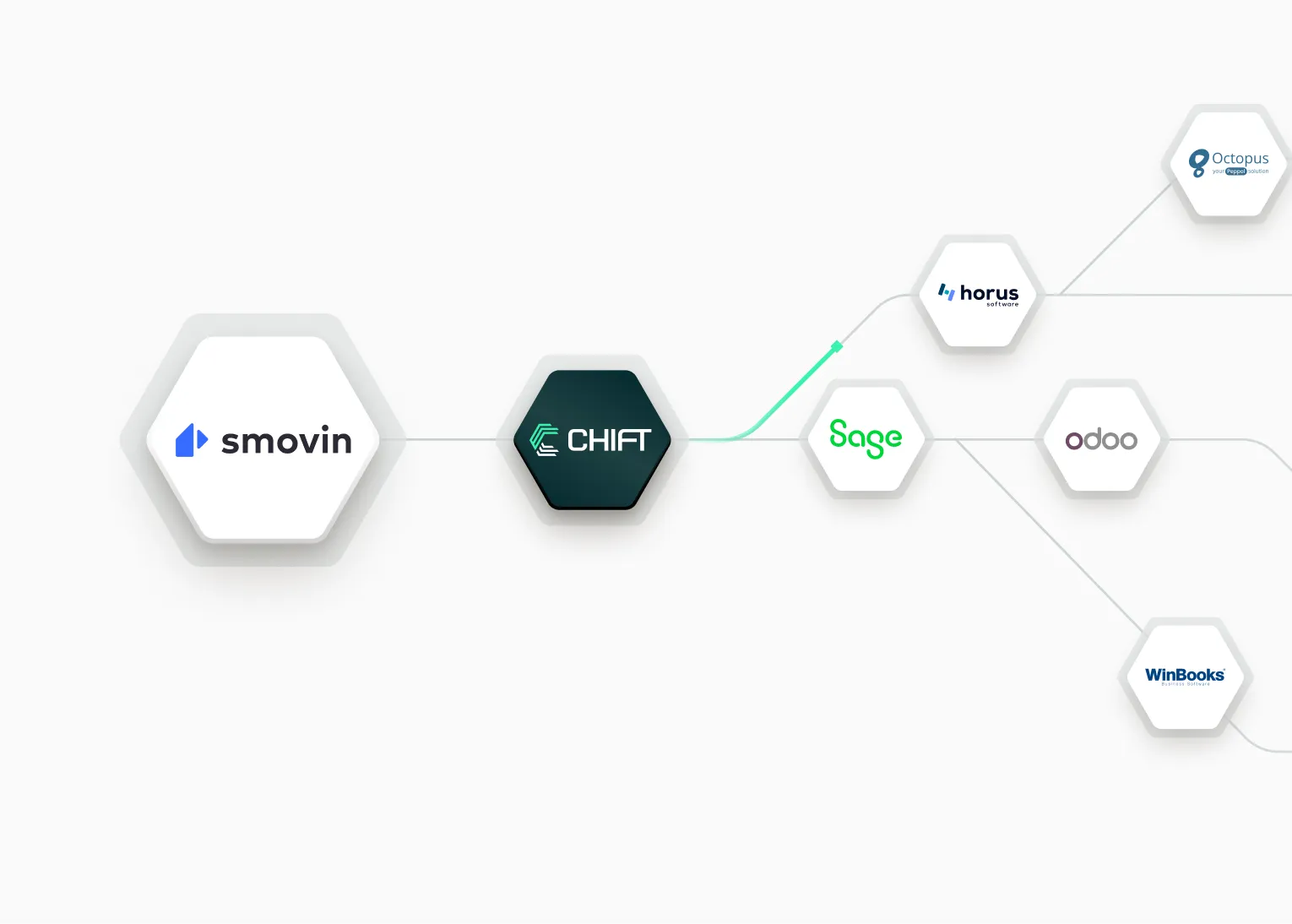
That's exactly the math Smovin ran. Smovin is a rental management platform, and before leaning on Chift for its accounting, banking, and financial connectivity, it weighed the cost of doing it all alone. The result: 70 to 80% less development and maintenance time on this kind of integration.
Here's why that choice became strategic, and what it changes in practice for a SaaS vendor.
Powerful software, rarely working alone
Companies never work with just one tool. They juggle accounting software, banking systems, financial tools, and sometimes external partners. For all of it to work, information has to flow between these environments, correctly and automatically.
That's what turned connectivity from a "nice bonus" into a real measure of value. Isolated software, however excellent, loses value if it doesn't fit into the tools its customers already use.
Philippe Bourez, CTO of Smovin, puts it well:
"Integrations clearly aren't just a nice to have. A rental management platform today has to be able to fit naturally into its customers' working environment."Philippe Bourez, CTO, Smovin
Rental management doesn't stop at the interface
Smovin, used to manage more than 50,000 properties, centralizes and automates rental management for owners, investors, and property managers. Its role isn't limited to storing or displaying information. It's about letting them run their business in a smoother, more reliable, and more automated way.
Take a simple example. Issuing a rent receipt then has to show up in the accounting. Without a connection between the tools, that means exporting, importing, re-entering, and checking by hand. With a smooth integration, the same operation becomes an automated flow: data is transmitted, categorized, and synced with no human intervention.
Before these integrations, the main point of friction was manual re-entry: double encoding, risk of error, harder collaboration with accountants, and a lot of time lost on low-value tasks. A problem that grows with the size of the portfolio.
"The bigger the portfolio under management, the more penalizing these frictions become."Philippe Bourez, CTO, Smovin
In other words, what works at a small scale quickly becomes unmanageable as the business grows.
Build it yourself, or lean on a partner?
It's the decision every SaaS vendor has to make. And it's no small one, because integrations are both strategic and complex.
Philippe Bourez points to three big challenges when you build an integration in-house:
- Technical diversity. Every third party has its own API, its own standards, its own limits, and its own level of maturity.
- Maintenance over time. An integration is never finished. You have to manage changes, errors, monitoring, resilience, and support.
- Product opportunity cost. Every hour spent rebuilding or maintaining an integration layer is an hour not spent on the core product.
That's why it makes sense to hand this layer to a partner. Not because it matters little, but precisely because it matters a lot and calls for very specific expertise.
"As a software vendor, we want to keep our energy on what makes Smovin specifically valuable: the product experience, the business logic, and the needs of the real estate sector."Philippe Bourez, CTO, Smovin
Why Smovin chose Chift
What won Smovin over was the chance to accelerate its integration strategy sharply, without rebuilding the whole connectivity layer itself. A partner able to bring a clear framework, save time, and keep the team focused on its core value.
Beyond the platform, the support mattered too: a smooth onboarding, direct and efficient exchanges, and above all people who understand the product stakes of a tech team that has to move fast without sacrificing quality.
"Working with a partner like Chift lets us move faster without diluting our product focus."Philippe Bourez, CTO, Smovin
The result: time given back to the product
The most visible gain is speed. But the real benefit lies elsewhere, in being able to keep the team focused.
"We estimate we've cut the development and maintenance time needed to deploy this kind of integration by 70 to 80%. That let us focus our product and tech team more on our core business rather than on connectivity with third-party systems."Philippe Bourez, CTO, Smovin
That's exactly where the value of an integration partner plays out: giving time back to the teams building the product.
What Chift changes for a SaaS vendor
The Smovin case shows what we do for all our clients. One single integration to Chift gives you access to a library of connectors that grows every month: accounting, invoicing, banking, payments, e-commerce, POS, and PMS. You activate new ones in one click, without starting from scratch every time.
And above all, we handle the part nobody wants to deal with: API changes, authentication, and data mapping. Your teams no longer have to maintain these building blocks.
- One single integration for a whole library of financial connectors
- A unified, standardized data model
- Authentication, pagination, and API rate-limit handling taken care of
- Real-time syncing and monitoring
- A European focus, with strong coverage of the tools that matter in Europe
- Human support, from a team that understands both the technical and the business side
Connectivity, the backbone of products in the AI era
This need for connectivity grows even stronger with AI. AI systems need structured, reliable, real-time data to be truly useful.
As Gauthier Henroz, CEO of Chift, puts it:
"A beautiful AI interface sitting on top of fragmented data is a race car engine with no fuel."Gauthier Henroz, CEO, Chift
That's why our MCP server and agentic sync layer make Chift an infrastructure built for AI-powered products. Connectivity isn't a technical detail. It's the fuel.
Do like Smovin
A successful integration is more than a connection between two tools. What really matters is data reliability, ease of setup, robustness over time, and real impact for the end user.
That's what we build with vendors like Smovin. Want to see what Chift can bring to your product? Book a demo with our team, or explore more client stories on our case studies page.
.webp)