Sweden is one of the most cloud-native accounting markets in Europe, and one of the most consolidated. Two platforms, Fortnox and Visma Ekonomi, account for the large majority of usage, and the line between SME tools and accountant tools has largely dissolved. Companies and their accounting firms work in shared cloud environments. For a SaaS vendor or fintech, that means connecting to Sweden is less about breadth and more about getting the two big players right.
This guide pulls the Sweden findings from our State of European Accounting Tech 2026 study, based on a survey of 1,400 SMEs and accountants across Europe, including 67 respondents in Sweden.
Sweden at a glance
- 1.2M SMEs
- 13 accounting tools named by Swedish respondents
- B2B e-invoicing mandate: not yet mandatory (B2G mandatory since 2019)
- 67 survey respondents
B2G e-invoicing has been mandatory in Sweden since 2019, while B2B remains non-mandatory, though widely used.
The role of accountants in Sweden
Sweden has two professional bodies covering the accounting sector: FAR, which represents authorised public accountants and auditors, and Srf konsulterna, the association for accounting and payroll consultants, whose 7,000 members serve approximately 330,000 companies. The distinction matters: Srf members are redovisningskonsulter rather than statutory auditors, and they routinely handle payroll alongside bookkeeping and compliance for their SME clients. Any company with annual turnover above SEK 3 million (around €300,000) is legally required to have an external auditor, ensuring broad, institutionalised demand for the profession.
Swedish SMEs tend to engage an accountant primarily for compliance and year-end reporting while managing day-to-day bookkeeping internally, often through cloud platforms like Fortnox. That pattern has directly shaped the collaborative, SME-first design of Swedish accounting software.
A market where cloud has won
Sweden stands out as a market where cloud adoption is deep, software consolidation is advanced, and the line between SME tools and accountant tools has largely dissolved.
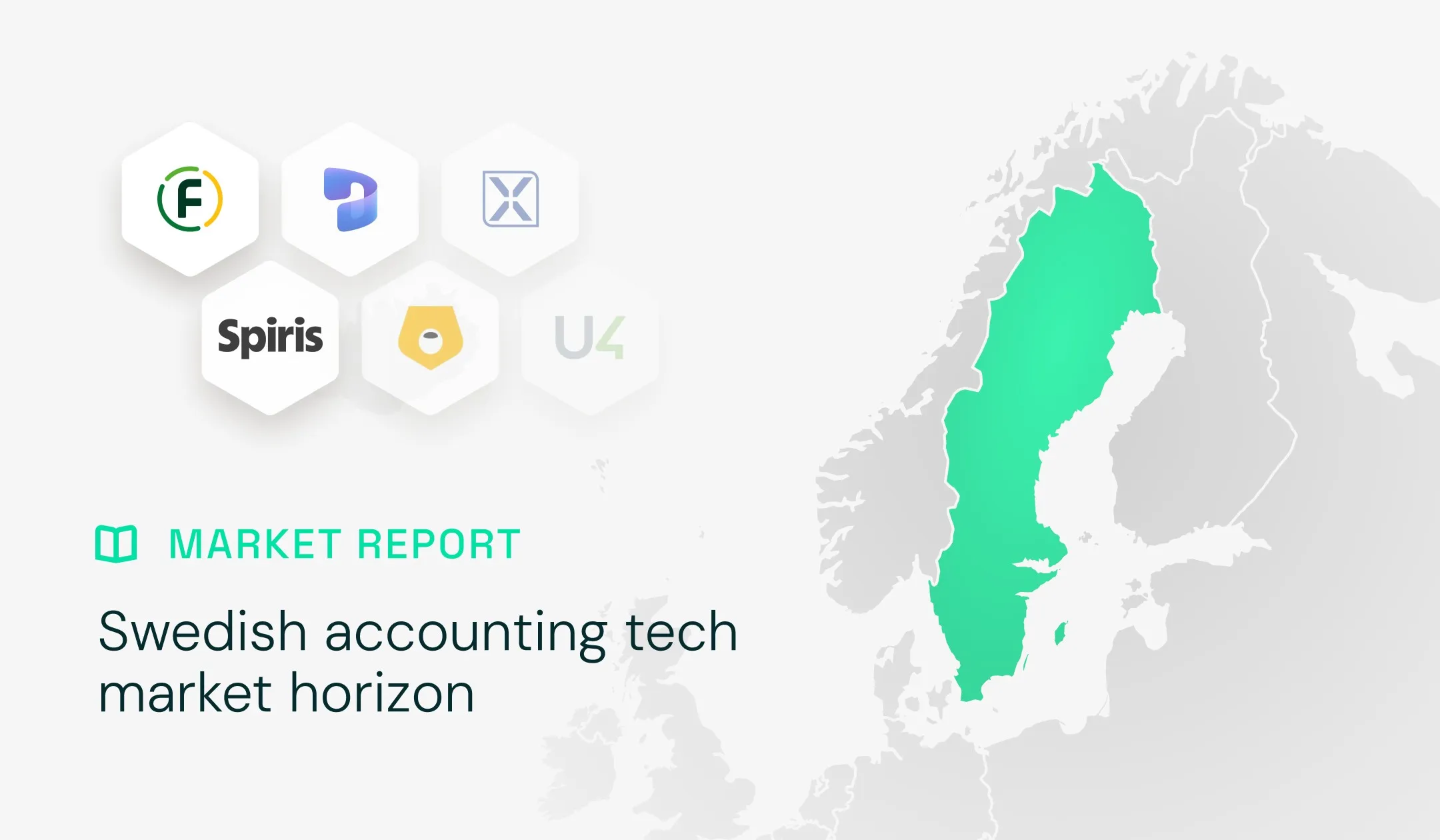
- Fortnox is the clear market leader, appearing in most multi-tool pairings as the primary platform. Built around shared access between SMEs and their accountants, it has set the standard for how Swedish accounting software works.
- Visma Spiris (formerly Ekonomi) is the second major ecosystem, serving both SMEs and accounting firms across a broad range of company sizes.
- Microsoft Dynamics and Unit4 cover the mid-market and larger organisations, while Xledger serves the upper SME and mid-market segment with a cloud-native, multi-entity focus.
- Björn Lundén and Hogia serve the accountant-facing layer, used primarily by firms managing client portfolios. Finago (formerly 24SevenOffice) is a growing cloud ERP active in the Swedish accounting firm channel.
What this means for software vendors
Fortnox's dominant position is consistent with all external signals. It's widely described as the main Swedish accounting platform, with particularly strong penetration among accounting firms, often cited as present in 80% or more of firms with five or more employees. The main likely omission in our data is SpeedLedger, which serves a smaller company segment than our survey covers.
One structural trend is worth watching: PE-backed consolidation is reshaping software usage in Sweden. Many investor groups have been acquiring independent practices at scale, and as they standardise software stacks across their portfolios, adoption decisions are increasingly made at group level rather than firm by firm.
""The digitalization of accounting is happening, but it's kind of stuttering. The big firms working with bigger businesses are totally digital. But the hundreds of thousands of small businesses in Sweden are not digital yet, at least a lot of them are still dealing with papers and emailing things."
— Dan Håfström, Editor in Chief, Balans
For a vendor, the good news is concentration: deep Fortnox and Visma connectivity covers most of the market, with Xledger and the ERP layer for larger SMEs. Keeping those integrations current as the platforms evolve is the ongoing work, and exactly what Chift is built to solve. One integration gives you access to a growing library of Swedish and European accounting connectors, with authentication, mapping and API maintenance handled for you.
Get the full picture
Sweden is one of ten countries we analysed in depth. The full State of European Accounting Tech 2026 report covers Belgium, France, Spain, Germany, the Netherlands, the UK, Italy, Denmark and Norway, plus the trends reshaping SME software, how businesses choose their tools, and why integration has become the defining battleground for accounting platforms.
Download the full white paper to get the complete market landscape, all the data, and the country-by-country breakdown.
Want to see how Chift can connect your product to Europe's accounting software? Book a demo with our team.
.webp)