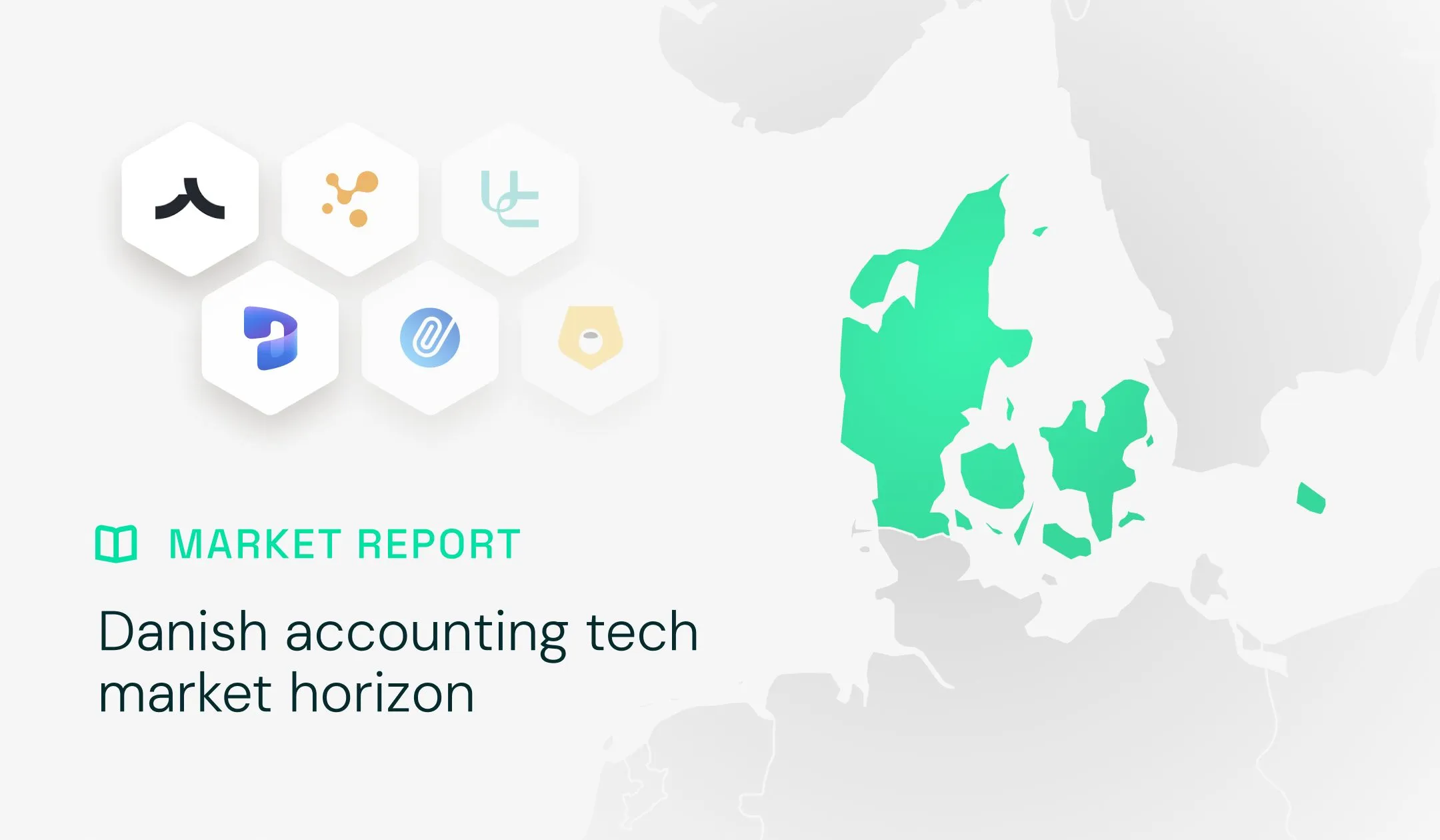
Denmark stands out as a market driven by regulation. The Danish Bookkeeping Act effectively ends the legal use of spreadsheets or manual ledgers for official accounting, making certified digital bookkeeping software the default for every business of meaningful size. The result is one of the most cloud-mature SME markets in Europe, structured around a small set of dominant, certified platforms. For a SaaS vendor or fintech, Denmark is a market where digital adoption isn't a trend, it's a legal requirement.
This guide pulls the Denmark findings from our State of European Accounting Tech 2026 study, based on a survey of 1,400 SMEs and accountants across Europe, including 67 respondents in Denmark.
Denmark at a glance
- 300K SMEs
- 14 accounting tools named by Danish respondents
- B2B e-invoicing mandate: not directly mandatory, but system capability is required
- 67 survey respondents
"In Denmark, businesses are legally required to use accounting software, you can't rely on tools like Excel. This creates a fundamentally different market dynamic, where digital adoption is not optional but built into regulation."
— Casper Bjarnason, Partner at Byfounders
How Denmark's regulation works
Denmark's approach is distinct from a standard B2B e-invoicing mandate. Rather than requiring e-invoices directly, the 2022 Bookkeeping Act mandates the use of certified digital bookkeeping systems capable of handling structured e-invoices, with phased rollout completing in January 2026. B2B e-invoicing itself isn't yet legally compulsory for every transaction, but the system-capability requirement makes it effectively the standard.
There's a second consequence vendors must plan for: any standard bookkeeping system sold in Denmark must go through a certification process with the Danish Business Authority before it can legally be marketed to Danish businesses. That's a practical barrier to entry.
The role of accountants in Denmark
Accounting firms influence software choice, particularly for larger SMEs and more complex compliance needs. The hybrid model is dominant: companies manage day-to-day bookkeeping internally but rely on accountants for compliance, annual reporting and tax filing. Regulation raises the cost of non-compliance and reinforces the value of standardised, certified workflows.
One dominant platform and a diverse long tail
Denmark's market has a clear structure built around one dominant platform and a diverse long tail of SME tools.
- Visma e-conomic is the central platform for Danish SMEs, consistently described externally as the undisputed market leader, serving both businesses and their accountants within the same environment.
- Dinero, Uniconta and Billy by Ageras serve the SME segment directly, with Dinero having particularly strong visibility among smaller companies.
- Microsoft Business Central (or Dynamics) covers larger SMEs and mid-market companies.
The market's real breadth extends well beyond what survey data can capture: our panel cited 14 distinct tools, yet over 100 bookkeeping systems are officially registered with the Danish Business Authority.
What this means for software vendors
External sources consistently describe Denmark as an e-conomic-centred SME market, which aligns with its position at the top of our ranking. A few tools are worth flagging as absent or under-represented: Zenegy is an emerging platform with good visibility that didn't appear in our survey, while Björn Lundén (following a 2022 acquisition) remains primarily a Swedish product still building its Danish footprint.
For a vendor, the path is clearer than in more fragmented markets: deep e-conomic connectivity first, then Dinero, Uniconta and Billy by Ageras for the SME segment, plus Business Central for the mid-market. The certification requirement and the sheer number of registered systems make ongoing maintenance the real cost.
This is exactly what Chift is built to solve. One integration gives you access to a growing library of Danish and European accounting connectors, with authentication, mapping and API maintenance handled for you.
Get the full picture
Denmark is one of ten countries we analyzed in depth. The full State of European Accounting Tech 2026 report covers Belgium, France, Spain, Germany, the Netherlands, the UK, Italy, Sweden and Norway, plus the trends reshaping SME software, how businesses choose their tools, and why integration has become the defining battleground for accounting platforms.
Download the full white paper to get the complete market landscape, all the data, and the country-by-country breakdown.
Want to see how Chift can connect your product to Europe's accounting software? Book a demo with our team.
.webp)