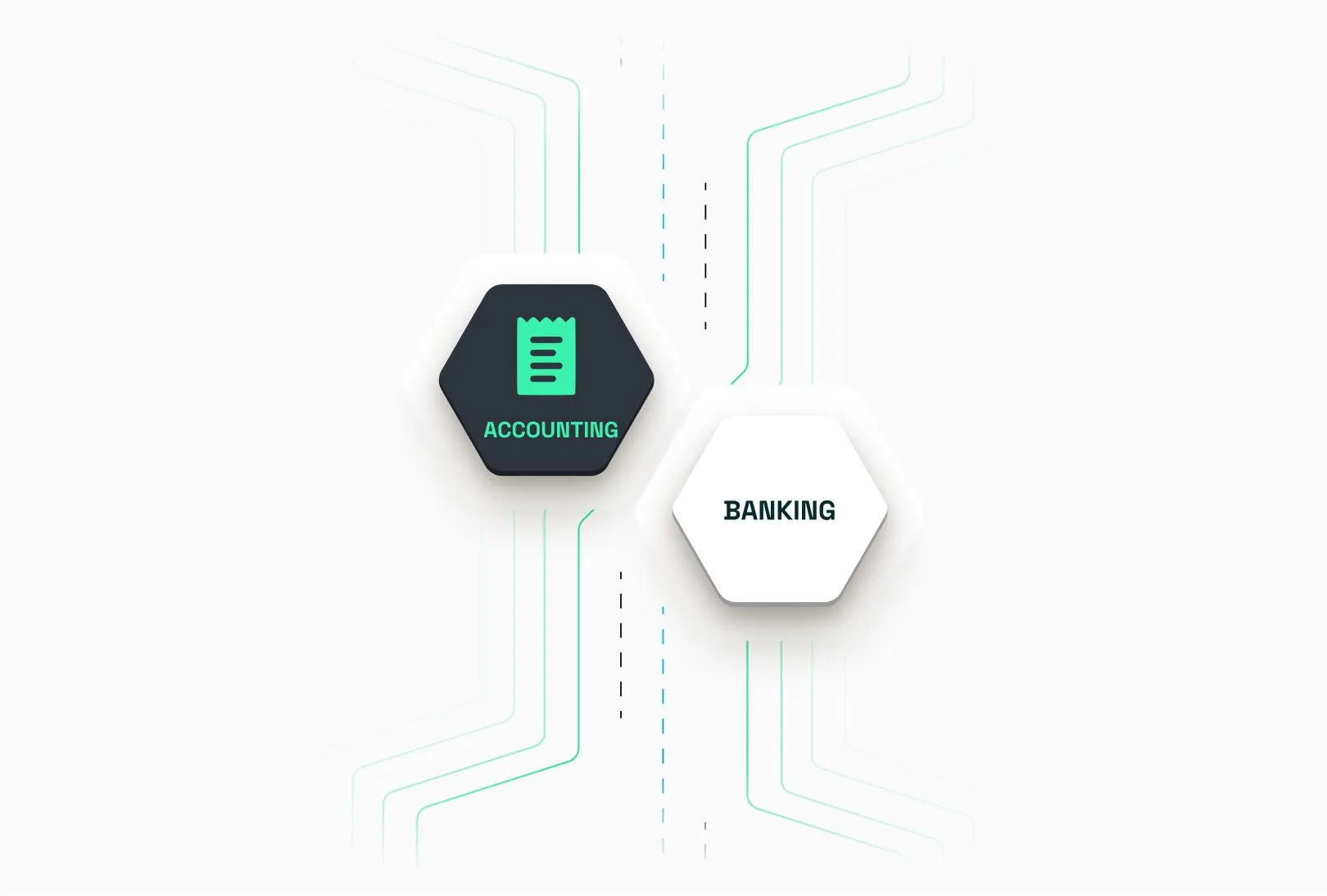
For banks serving businesses, connecting to accounting software has become essential. Every business operates across two financial realities: actual bank transactions and how those transactions are recorded in accounting. These systems need to stay synchronized, and businesses increasingly expect this to happen automatically.
This article explores use cases that banking-accounting integration enables, why these integrations matter for financial innovation, and how banks and fintechs can leverage this infrastructure for competitive advantage.
The banking-accounting integration gap
Every business operates across two parallel financial realities:
- Banking - actual money moving in and out of bank accounts
- Accounting - how those movements are recorded, categorized, and reported
These two realities must stay synchronized. When a payment leaves a business bank account, it needs to appear correctly in their accounting books. When an invoice is paid, both systems need to reflect that transaction.
Traditionally, this synchronization happened manually: accountants downloaded bank statements, matched transactions to invoices, and posted entries one by one. This process was slow, error-prone, and didn't scale.
Modern businesses expect real-time synchronization. They want their accounting software to show live bank balances, automatic transaction categorization, and instant reconciliation. Banks and fintechs that can deliver this experience gain a significant competitive advantage.
But building these integrations is harder than it looks.
Why banking integrations are uniquely complex
Banking data seems simple, just transactions flowing between systems. But the reality is far more nuanced:
Two technical routes for the same use case
Modern bank feed integrations can take two fundamentally different paths:
Route 1: Direct accounting entries
Bank transactions are immediately posted as journal entries in the general ledger. This works well for traditional accounting systems that expect structured accounting data from the start.
Route 2: Bank statement objects
Transactions are first imported as bank statements or transaction records, allowing reconciliation workflows before final accounting entries are posted. This approach dominates in modern ERPs and provides better user experience through semi-automated matching.
The challenge? Different accounting platforms support different routes. NetSuite only accepts bank statement lines. DATEV requires direct accounting entries. Exact Online supports both but with different data requirements.
A scalable banking integration needs to handle both routes intelligently, selecting the right approach per connector while maintaining consistent data quality.
Reconciliation logic varies dramatically
Some systems auto-match transactions to invoices. Others require manual intervention. Some can handle partial payments and multi-currency reconciliation. Others cannot.
Building a bank feed that "just works" across dozens of accounting platforms means handling all these variations at the infrastructure level.
Beyond transaction sync
Neo-banks and digital banking platforms are uniquely positioned to go beyond basic transaction sync and deliver value-added accounting features.
Spend management meets accounting
When a company card is swiped, the banking app knows:
- Who made the purchase
- What merchant category it fell into
- Whether it needs approval or receipt upload
- How it should be categorized for tax purposes
This contextual data is invaluable for accounting, but it only creates value if it flows seamlessly into accounting systems. Neo-banks that can push enriched transaction data, complete with categorization, merchant details, and attached receipts, dramatically reduce manual accounting work.
The technical challenge: Each accounting platform structures this data differently. Expense categories in Qonto need to map to chart of accounts in Pennylane, cost centers in Sage, and tax codes in DATEV.
Bill pay and accounts payable automation
The next evolution is bidirectional: not just pushing bank data into accounting, but enabling payments directly from accounting software.
A business reviews unpaid invoices in their accounting system and clicks "Pay via [Bank]." The payment is initiated through the banking API, the accounting entry is posted automatically, and both systems stay synchronized.
This workflow eliminates:
- Manual payment file uploads
- Reconciliation delays
- Data entry errors
- Context switching between banking and accounting
But it requires deep integration on both sides: payment initiation APIs from the bank, invoice and payment posting capabilities in accounting software, and reliable reconciliation logic to match payments back to accounting records.
Read more about bank feeds on our bank feeds article.
The lending use case: from banking data to credit decisions
One of the most compelling applications of banking-accounting integration is embedded lending.
Banks and fintechs sitting at the intersection of banking and accounting data have unique visibility into business financial health:
Data-driven credit assessment
Traditional business lending relies on historical financial statements. Open banking brought real-time transaction visibility.
Accounting data reveals:
- Outstanding invoices and payment terms - revenue that's booked but not yet received
- Accounts receivable aging - how quickly customers actually pay
- Supplier payment patterns - early warning signs of cash flow stress
- Revenue recognition and seasonality - understanding business cycles beyond simple transaction volume
When a bank combines banking transactions with accounting records, credit assessment becomes:
- Real-time - decisions based on current financial position, not outdated statements
- Contextual - understanding the full picture: what's owed, what's expected, what's at risk
- Predictive - detecting patterns that indicate future financial health or stress
- Automated - programmatic analysis of working capital, revenue stability, and operational trends
A business might show healthy transaction volume but have deteriorating payment terms with customers. Or strong revenue but concerning supplier payment delays. Accounting data reveals these critical nuances.
Instant credit offerings
With reliable financial data flowing through unified infrastructure, credit decisions can happen in minutes rather than weeks:
- Application - business applies for credit within their banking app or accounting software
- Data pull - system retrieves banking transactions and accounting data automatically
- Assessment - algorithms analyze financial health, revenue stability, and risk indicators
- Decision - instant approval or decline based on real-time data
- Disbursement - funds transfer immediately to business account
This speed and convenience are only possible when banking and accounting integration infrastructure is robust and standardized.
Ongoing monitoring and dynamic limits
Real-time data access enables lenders to:
- Monitor loan performance continuously
- Adjust credit limits based on business growth
- Detect early warning signs of financial stress
- Offer proactive support or restructuring when needed
Rather than static loan agreements based on point-in-time data, embedded lending becomes a dynamic relationship that evolves with the business.
The opportunity: Banks that invest in accounting integration infrastructure can:
- Reduce manual support requests
- Improve customer retention through embedded workflows
- Gather better data for credit and treasury services
- Cross-sell financial products based on accounting insights
Regional coverage as competitive moat
Once a bank connects to dozens of accounting platforms through unified infrastructure, adding new platforms becomes faster, maintaining integrations scales efficiently, and new use cases become feasible.
Banking commodities, accounts, cards, payment rails, are table stakes. Differentiation comes from sitting at the intersection of banking and accounting data. This position enables:
- Intelligent cash management and payment automation
- Context-aware credit decisions
- Financial insights delivered where businesses actually work
The bank that understands a business's complete financial operations, not just transaction flows, can serve that business better, transforming the relationship from "provider of accounts" to "infrastructure for financial operations."
The infrastructure layer: why Chift built for banking
Chift helps solving the banking-accounting integration challenge at scale.
Chift supports both banking integration approaches natively:
Financial entries route: for direct accounting entry posting
- Covers: Traditional accounting systems, local platforms, legacy ERPs
- Enables: Pre-accounting automation, fee detection, supplier matching
Bank transactions route: for statement-based reconciliation
- Used by: Modern ERPs, global accounting platforms
- Covers: NetSuite, Odoo, Sage Intacct, Yuki, MS Dynamics
- Enables: Automated reconciliation workflows, invoice matching, smoother UX
This dual approach means fintechs don't need to build separate integration strategies for different connector types. The infrastructure selects the right route automatically while maintaining data consistency.
European coverage at scale
The real value of infrastructure is coverage. Chift connects to:
- Local accounting platforms in Europe
- Regional ERPs and mid-market systems
- Global platforms like NetSuite, Sage, Xero, QuickBooks
- Specialized tools for hospitality, retail, professional services
For banks and fintechs expanding across Europe, this coverage is the difference between "works in one market" and "scales across the continent."
Network effects through unified integration
Once a bank connects to dozens of accounting platforms through unified infrastructure, adding new platforms becomes faster, maintaining integrations scales efficiently, and new use cases become feasible.
Banking commodities, accounts, cards, payment rails, are table stakes. Differentiation comes from sitting at the intersection of banking and accounting data. This position enables:
- Intelligent cash management and payment automation
- Context-aware credit decisions
- Financial insights delivered where businesses actually work
The bank that understands a business's complete financial operations, not just transaction flows, can serve that business better, transforming the relationship from "provider of accounts" to "infrastructure for financial operations."
Data advantage for financial services
Banks with accounting integration access have unique data visibility:
- Revenue trends and growth trajectories
- Cash flow patterns and working capital needs
- Expense management and cost structure
- Customer payment behavior and credit risk indicators
The bank that understands a business's financial operations can serve that business better than one that only sees transaction flows.
Building for the next decade of financial infrastructure
The banks and fintechs winning in the next decade will be those that treat accounting integration as strategic infrastructure, not an afterthought.
For neo-banks, it's the foundation for embedded financial services that go beyond basic banking. For traditional banks, it's the path to staying relevant in a world where businesses expect seamless digital workflows.
The question isn't whether banking and accounting will connect, they already are. The question is whether your organization has the infrastructure to deliver on that connectivity at scale, across markets, and with the reliability that financial operations demand.
At Chift, we're building that infrastructure for Europe's most ambitious banks and fintechs. From bank feeds to embedded lending, from transaction sync to pre-accounting automation, the foundation is unified integration that just works.
Curious how your organization can leverage banking-accounting infrastructure for competitive advantage? Talk to our team.
.webp)
.jpg)