.webp)
ACD is a well-established accounting software widely used by accounting firms and SMEs, particularly in France. Known for its robustness and deep functional coverage, ACD plays a central role in the daily workflows of many accountants.
Offering integrations to accounting software such as ACD provides several key benefits for a software vendor. Here are some of them:
- Enhanced product value: make your offer more attractive to businesses that rely on seamless financial management.
- Customer retention and satisfaction: make your software more user-friendly, enable automations and reduce the need for manual data entry.
- Broadened market reach: businesses only use tools that integrate with the software they are already using.
- Increased revenue opportunities: customers may be more willing to purchase higher-tier plans or that work well with their existing accounting tool.
In this article, we’ll explore how the ACD API works, common integration use cases, how to set it up, and how Chift helps you connect faster with minimal effort.
What is the ACD Accounting API?
The ACD API provides programmatic access to accounting data stored in ACD environments. It is designed to support integration use cases for modern software platforms interacting with accountants and financial data.
Technical overview
- REST-based API
- JSON payloads
- Comprehensive endpoint coverage across accounting objects
- Interactive Swagger documentation, allowing developers to explore, test, and reproduce requests easily
The API is particularly detailed, making it suitable for advanced accounting use cases such as journal entries, balances, and financial reporting.
Chift leverages the ACD API to normalize accounting data and expose it through a unified interface compatible with other accounting systems.
Connect to all popular solutions with a single integration
Discover how Chift's Unified APIs have helped software vendors quickly add dozens of integrations.
What can you build with an ACD API integration?
Connecting ACD through Chift enables a wide range of use cases across accounting, finance, and payments. Here is some of the most common ones:
Automated accounting flows for SMBs – Axonaut
ERP solutions like Axonaut can push or retrieve accounting data from ACD to automate bookkeeping workflows. This eliminates manual data entry, keeps books up to date, and improves collaboration between business owners and accounting firms.
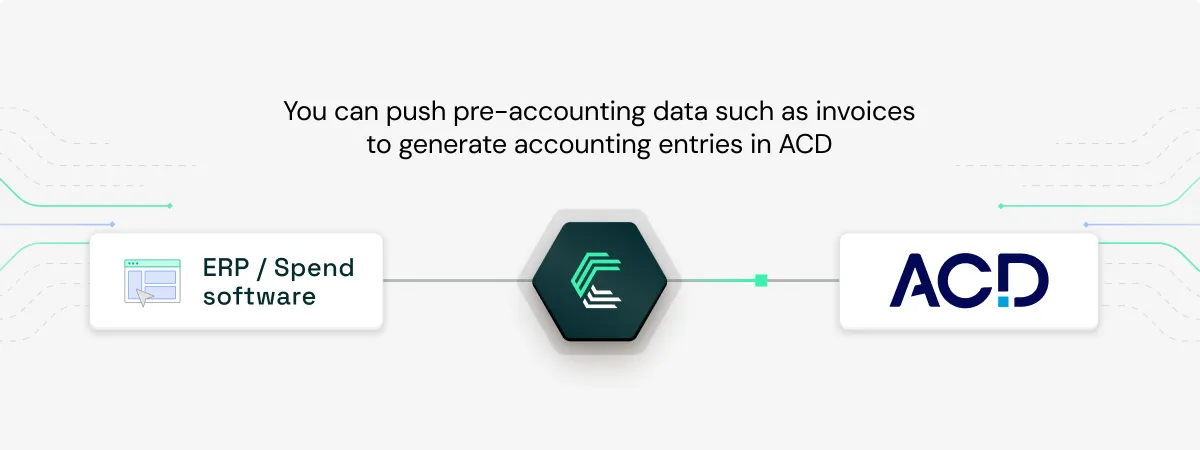
Read our Axonaut case study to learn more.
Cashflow monitoring and forecasting – Agicap
Agicap can pull balances, journal entries, and financial data from ACD to offer accurate, accountant-grade cashflow insights. It also pushed pre-accounting data to ACD to generate accounting entries.
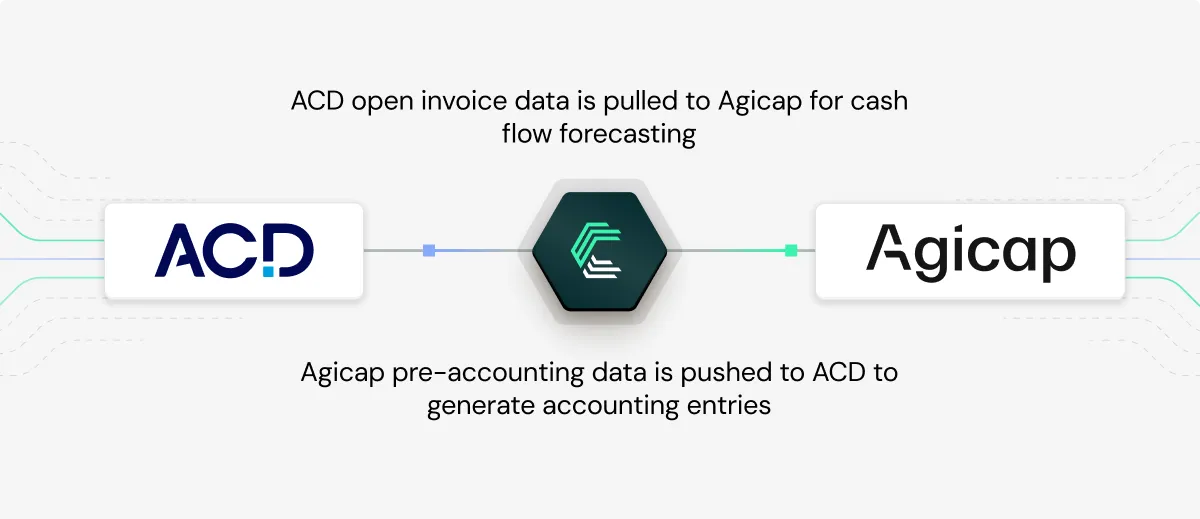
Find out more in Agicap’s case study.
Connecting vertical SaaS software to accounting
Users of Graneet (construction) can export financial records such as supplier or client invoices and generate accounting entries in ACD (and other tools) in just a few clicks. This automation reduces repetitive tasks and minimizes human error, saving time for both business owners and their accountants.
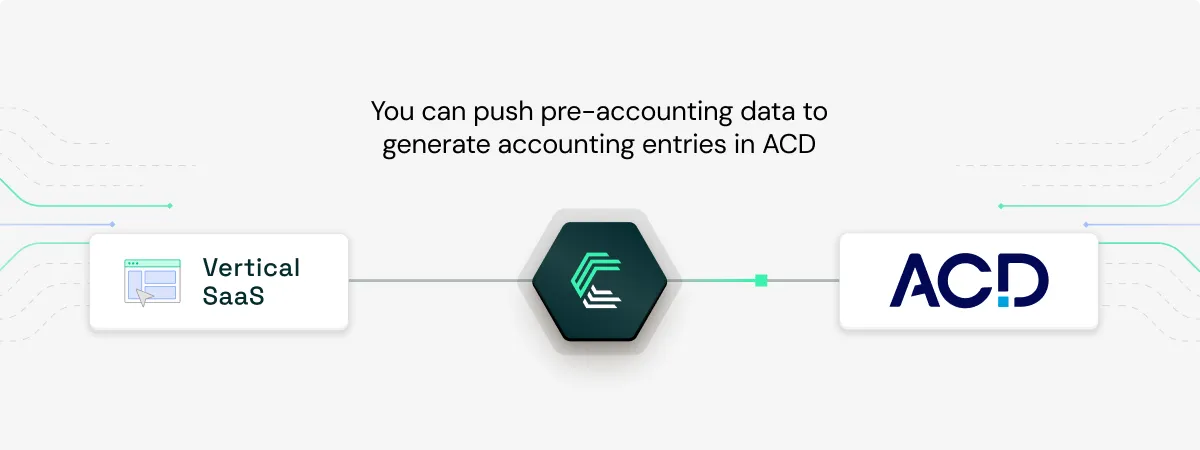
To learn more: How Graneet automates accounting workflows thanks to Chift’s Unified API.
Automate debt recovery workflows with open invoice data
Debt recovery platforms like Recovr, LegalCity, and Rubypayeur connect to ACD via Chift to automatically retrieve open receivables and trigger debt collection processes. This eliminates manual tracking and ensures timely action on unpaid invoices.
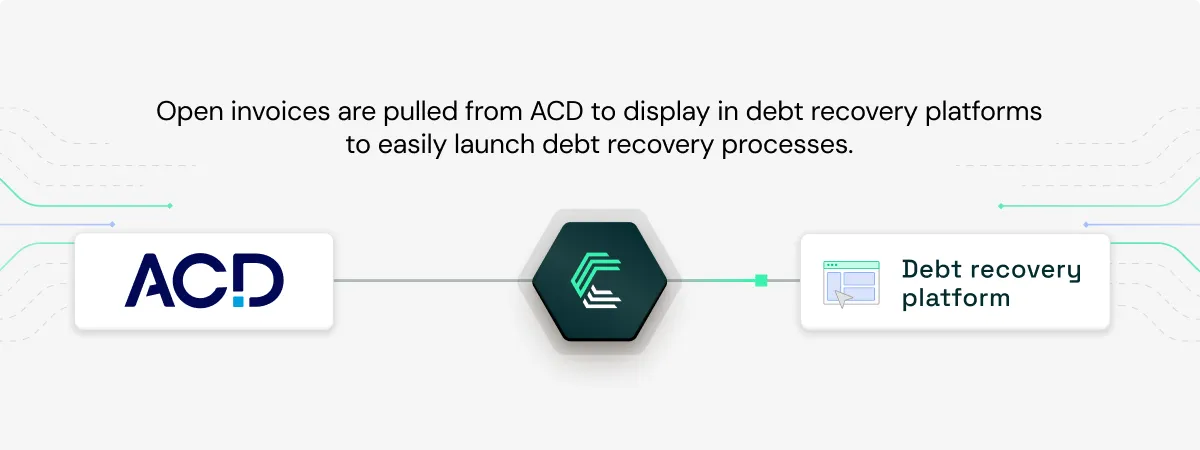
Read the full case study here: How Recovr automates debt recovery with Chift’s integration solutions
How does the ACD integration setup work?
Connecting to ACD requires careful configuration on the client side to ensure secure and correct access.
Key setup requirements
- ACD version requirement
The ACD installation must be running a version higher than version 23. This ensures compatibility with the API and related services (e.g., i-Suite Expert). (This should be verified with ACD support if the version naming differs.) - i-Suite Expert subscription
You must be a customer of the i-Suite Expert module from ACDL. The API surface and user access needed for integration rely on features provided by this module. - Correct ACD user type for API access
The ACD user account used for connecting to the API must be of type “Collaborator” (not “Utilisateur” or generic “User”). This user type typically supports broader access and proper authentication for API-based workflows. - The accounting folder must be properly shared, with the correct permissions enabled
- Clients must provide accurate connection information (credentials, folder access)
- Some back-and-forth may be required if credentials are incorrect or the folder has not been configured correctly
Chift supports this onboarding process and helps identify configuration issues early to reduce integration friction.
Best practices when integrating with the ACD API
To ensure a smooth and maintainable integration, we recommend the following:
- Work closely with ACD’s support team
- ACD-specific configuration can be subtle. Direct communication helps resolve edge cases quickly.
- Create a dedicated ACD user for the integration
- This simplifies secret management and improves security and traceability.
- Validate access and permissions early
- Many issues stem from missing folder sharing or incorrect rights. Verify this upfront.
These practices significantly reduce integration issues in production.
Why connect ACD through Chift’s Unified Accounting API?
Building a direct ACD integration means handling authentication, permissions, schema mapping, and long-term maintenance.
With Chift, you benefit from:
- A single Unified Accounting API covering ACD and many other accounting platforms
- Normalized data models across accounting systems
- Reduced integration and maintenance effort
- Faster deployment and easier scaling across your customer base
You integrate once and gain access to ACD alongside the rest of the accounting ecosystem.
Connect to ACD and scale your accounting integrations
Whether you're building an accounting platform, a cashflow tool, a lending product, or a payment solution, access to ACD data unlocks powerful new value.
Chift makes that access simple, secure, and scalable. With a single integration, connect not only to ACD but also to Pennylane, Inqom, MyUnisoft, Xero, A3ERP, and many more.
Want to see it in action? Book a demo and discover how Chift connects you to ACD, and far beyond.
ACD API FAQ
What endpoints are available within Chift’s ACD API?
Chift’s ACD connector gives you access to a wide range of end-points, including but not limited to:
- Clients /clients
- Suppliers /suppliers
- VAT Codes /vat-codes
- Journal Entries /journal-entries
Consult our ACD API documentation for a full list of available routes.
What about ACD API rate limits?
ACD does not publicly document API rate limits.
Even without formal limits, it’s recommended to:
- Avoid unnecessary polling
- Fetch data incrementally
- Schedule synchronizations thoughtfully
Chift structures API calls efficiently to ensure stability and scalability.
.webp)