Electronic invoicing is coming. Between PEPPOL in Belgium and the Netherlands, Approved Platforms (PA) in France, Verifactu in Spain, SDI in Italy, KSeF in Poland, SAF-T in Portugal, and MTD in the United Kingdom, it's easy to get lost. Yet behind these acronyms lies a simple transformation to understand, and a major opportunity for the accounting ecosystem.
What is Electronic Invoicing concretely?
Forget the technical terms for a moment. Electronic invoicing is simply the issuance of an invoice by one company and its automatic reception by another company, at a national level.
Concretely, invoicing software will be connected to each other through standardized flows. The flow has different names depending on the country, but the principle remains the same.
A simple analogy with phones and SIM cards: You don't see your SIM card, you see your phone that sends messages. Similarly, you won't see PEPPOL or Approved Platforms: you'll see your invoicing software. It's up to the software to be connected to the network, regardless of which "SIM card" is used.
What to remember: each company will need to have a tool to issue compliant invoices and a tool to receive them. These two functions can be provided by the same software... or not. The choice will depend on the specific needs of each structure.
And what about E-reporting?
E-reporting is the reporting counterpart to electronic invoicing. While electronic invoicing concerns domestic B2B exchanges, e-reporting broadens the scope: it notably includes international invoices (which will continue to be sent by email until countries become interoperable), B2C invoices, and cash register Z tickets.
The objective for States? To have a real-time view of companies' VAT positions. This is actually the main reason for this reform: to combat VAT fraud, estimated at several billion euros per year in Europe.
Direct consequence: e-reporting will impose a more intensive data transmission schedule, forcing companies and accountants to synchronize their information much more frequently than today.
Not all countries are implementing e-reporting immediately, but it's the end goal of the entire system. We detail the e-reporting challenges in this article.
The European calendar: where are we?
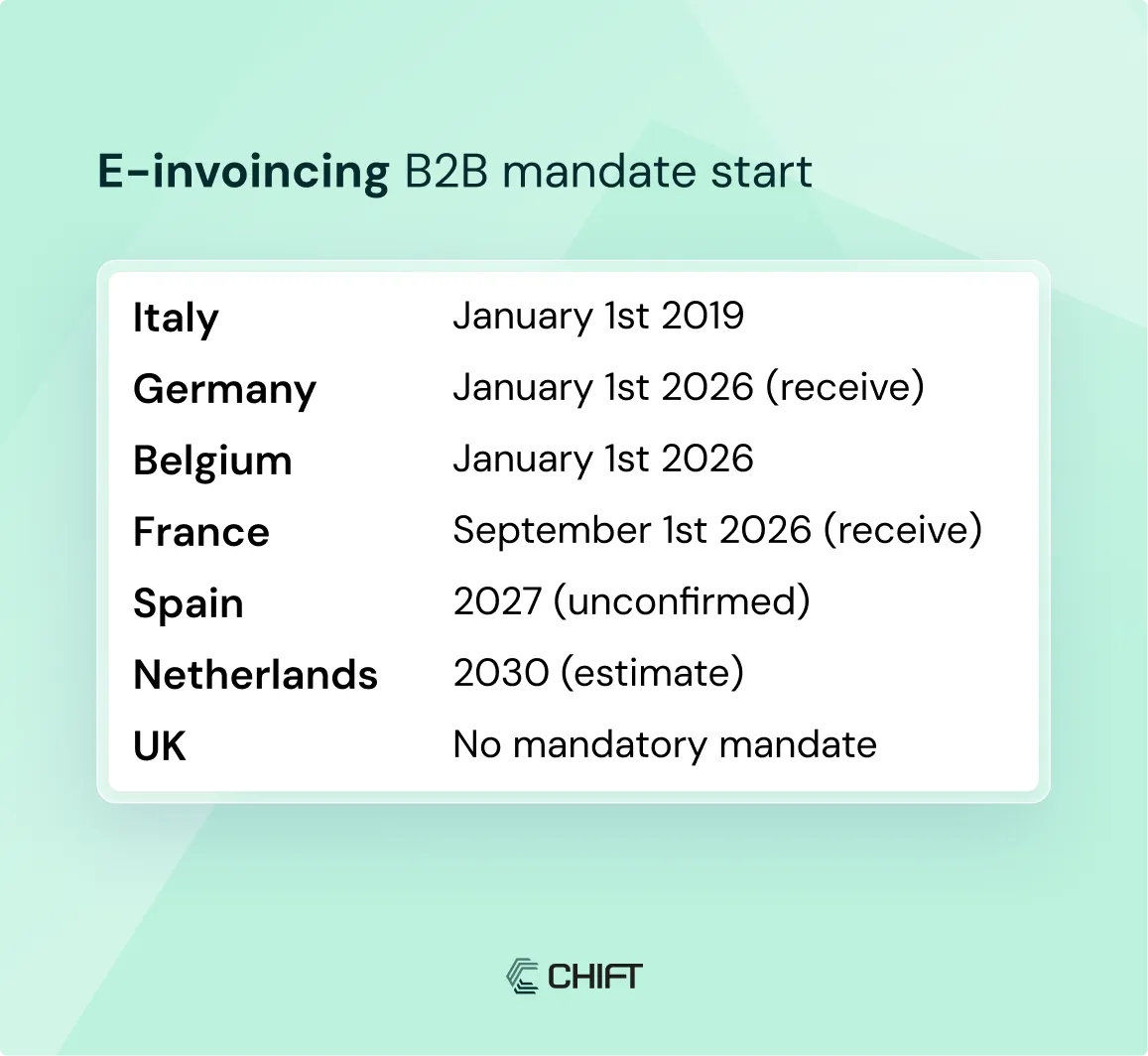
Deadlines vary by country, but the direction is clear: all of Europe is converging toward mandatory electronic invoicing. For example:
Belgium: from January 1, 2026, all VAT-registered companies must be able to send and receive electronic invoices via PEPPOL. One month before the deadline, only 50% of Belgian companies are registered on the network.
France: deployment happens in two phases.
On September 1, 2026, large companies begin issuing. Direct consequence: all companies, regardless of size, must be able to receive electronic invoices.
On September 1, 2027, the obligation to issue and receive applies to all VAT-registered companies.
Other European countries: Italy is a pioneer with its SDI system (Sistema di Interscambio) in place since 2019. Spain is deploying Verifactu, Poland is preparing KSeF (Krajowy System e-Faktur), Portugal uses SAF-T for tax reporting, and the United Kingdom has implemented MTD (Making Tax Digital). The Netherlands has adopted PEPPOL as a standard. The Nordic countries (Norway, Denmark, Sweden, Finland) are also preparing B2B obligations, with Denmark targeting January 2026. Each country is moving at its own pace, but the direction is shared.
Impact for companies: three starting situations
All companies today have an accounting tool, often managed by an external chartered accountant if it's an SME. But not all have the right management tools for invoicing yet.
Situation 1: the company has no management tool
These companies still invoice via Word or Excel. This represents a considerable number of structures: an estimated 2.5 million French companies without dedicated invoicing tools in 2025.
For them, the change will be significant but beneficial: the legal obligation will push them to equip themselves, with substantial productivity gains as a result. These companies will need to choose both an invoice issuance tool and an invoice reception tool. This is actually the segment that many publishers are currently targeting with a simple and accessible offer.
Situation 2: the company has invoicing software (Accounts Receivable)
The majority of SMEs already have invoicing software, a commercial management tool, or an ERP. There are many tools depending on business needs.
The diversity of software reflects the diversity of needs: a company managing inventory doesn't have the same requirements as a consulting firm. This actually explains the rise of vertical software, specialized by sector. These companies will simply need to ensure their current tool is compatible with the new standards for invoice issuance.
However, they are often not equipped to receive invoices (Accounts Payable). Indeed, an email inbox is often still the main tool. These companies will need to choose software to receive their supplier invoices. This will often be the platform recommended by their chartered accountant.
Situation 3: issuance and reception already in place
A minority of companies, generally the most structured, already have a supplier invoice management tool (AP/procurement) in addition to their invoicing solution. For them, adaptation will be minimal: it will mainly involve verifying the compliance of their existing tools.
Impact for chartered accountants: advise without imposing, and become a true pilot
Electronic invoicing transforms the relationship between the chartered accountant and their clients, but not in the way one might think.
The client remains master of their choices
Each company chooses its tools based on its own needs. A gardener, a lawyer, a trading company, or a consultant won't have the same requirements. The chartered accountant can guide clients who have nothing toward a preferred solution, but it's the client who has the final say.
And this is normal: no one knows a company's operational constraints better than the company itself.
The real issue: connectivity with client tools
The only legitimate concern for the chartered accountant is that the tool chosen by their client can connect to their own accounting production tool.
It would be paradoxical for B2B flows to be fully automated thanks to electronic invoicing... but for the flow to accounting to remain manual. Especially with e-reporting which will impose more frequent transmission schedules.
This is precisely where Chift comes in. Our platform allows invoicing, management, or ERP software to integrate natively with accounting tools used by chartered accountants. And conversely, we help accounting software publishers extend their connectivity to the ecosystem of management tools.
The real opportunity for chartered accountants: moving from production to management
Real-time data access opens the door to new high-value services: financial management, debt collection follow-up, dashboards, cash flow forecasting...
The chartered accountant can move from a production role (data entry, declarations) to an advisory and management role. This is an outsourcing of the financial department that goes well beyond pure accounting. Firms that can position themselves on these services will have a decisive competitive advantage.
But to achieve this, data must flow automatically from the client's tools.
Impact for software publishers: accounting integration becomes a must-have
For all software publishers with financial data, electronic invoicing changes the game. Whether it's invoicing, cash register, treasury, or expense management software. Accounting integration is no longer optional.
Invoicing software that isn't connected to the client's accounting becomes a hindrance. In the age of automated flows, asking a user to manually export their data to their accountant is stone age.
Publishers must be able to push invoices (customer and supplier) or financial data to the accounting software, and ideally synchronize payments to enable automatic matching.
This is exactly Chift's mission from the start: to enable software publishers to connect to the European accounting ecosystem via a unified API, without having to develop and maintain dozens of individual integrations.
Huge improvement opportunity for publishers: integrated payment
Once the company is equipped to receive its invoices, the natural demand will be to be able to pay directly from the tool where it receives its supplier invoices, without switching to the banking interface.
Some players (Revolut Business, Wise, or Banking-as-a-Service solutions like Swan) have understood this well and already offer integrated payment features.
The complete scheme then becomes: invoice receipt → validation → payment → automatic accounting entry → matching. All without leaving your management tool.
This is a considerable time saving for the entrepreneur, a great opportunity for publishers, and a direct threat to the banking sector that doesn't integrate into the ecosystem.
The ecosystem must be connected
This is the crucial point. Even competing publishers will need to connect to each other. A publisher may offer both invoicing and accounting, but ultimately, it's the client who chooses their tools based on their needs. Specialized invoicing software for lawyers must be able to interface with the accounting software that the chartered accountant uses, even if they are competing solutions otherwise.
This interoperability is the key to a smooth experience for the end user and their chartered accountant. Open software will be the winners of the electronic invoicing reform.
Chift: The Missing link in the ecosystem
Electronic invoicing accelerates a fundamental trend: the necessity for all players in the financial ecosystem (invoicing software, ERPs, accounting tools, banks, fintechs) to be interconnected.
At Chift, this has been our mission from day one. Our unified API allows software publishers to connect to most accounting solutions across Europe, and accounting tools to receive flows from the entire ecosystem.
Concretely, this means:
For invoicing and management software publishers: native accounting integration, without heavy development, that works with the tools used by your clients' chartered accountants.
For accounting software publishers: extended connectivity to management tools used by companies, whatever their sector specialization.
For chartered accountants: assurance that their clients' data flows automatically, regardless of the tool chosen by the company.
Electronic invoicing is not just another regulatory constraint. It's the catalyst for a profound transformation of companies' financial processes, and Chift is here to support this transformation.
Are you a software publisher and want to connect your solution to the European accounting ecosystem? Contact us
.webp)
.jpg)