Germany is the most accountant-driven accounting market in Europe. For the vast majority of German SMEs, accounting isn't managed internally, it's fully delegated to a Steuerberater (tax advisor) who handles compliance, statutory reporting and often payroll too. The result is a market that consolidates around accountant ecosystems, with one platform sitting at the centre: DATEV. If you're a SaaS vendor or fintech, understanding that gravitational pull is step one.
This guide pulls the Germany findings from our State of European Accounting Tech 2026 study, based on a survey of 1,400 SMEs and accountants across Europe, including 200 respondents in Germany.
Germany at a glance
- 3.1M SMEs
- 21 accounting tools named by German respondents
- B2B e-invoicing mandate: gradual rollout 2027-2028 for issuing
- 200 survey respondents
Because accounting is outsourced to the Steuerberater, software adoption is largely determined by the accountant, not the business owner. The SME typically has no direct interaction with the production accounting system used on its behalf.
Why accountants decide everything in Germany
Accountants are the primary software decision-makers in Germany, more so than in any other market in our panel. Compliance and statutory reporting are legally and operationally bound to the Steuerberater's workflow, so SMEs have little to no direct role in selecting software. Accountants also routinely manage payroll for their clients, deepening their integration into the SME's operational infrastructure.
That makes the accountant ecosystem not just a distribution channel, but the functional backbone of the entire German accounting software market. For vendors, the message is blunt: win the accountant, or you don't win Germany.
How Germany's e-invoicing mandate rolls out
Germany's B2B e-invoicing mandate arrives in three stages:
- Since 1 January 2025, all businesses must be able to receive structured e-invoices.
- From 1 January 2027, issuing becomes mandatory for companies with annual turnover above €800,000.
- From 1 January 2028, the obligation extends to all remaining businesses.
This phased timeline keeps compliance pressure on software vendors high through 2028.
A "backbone + layers" market built around DATEV
Germany has a clear structure: one backbone, with layers around it.
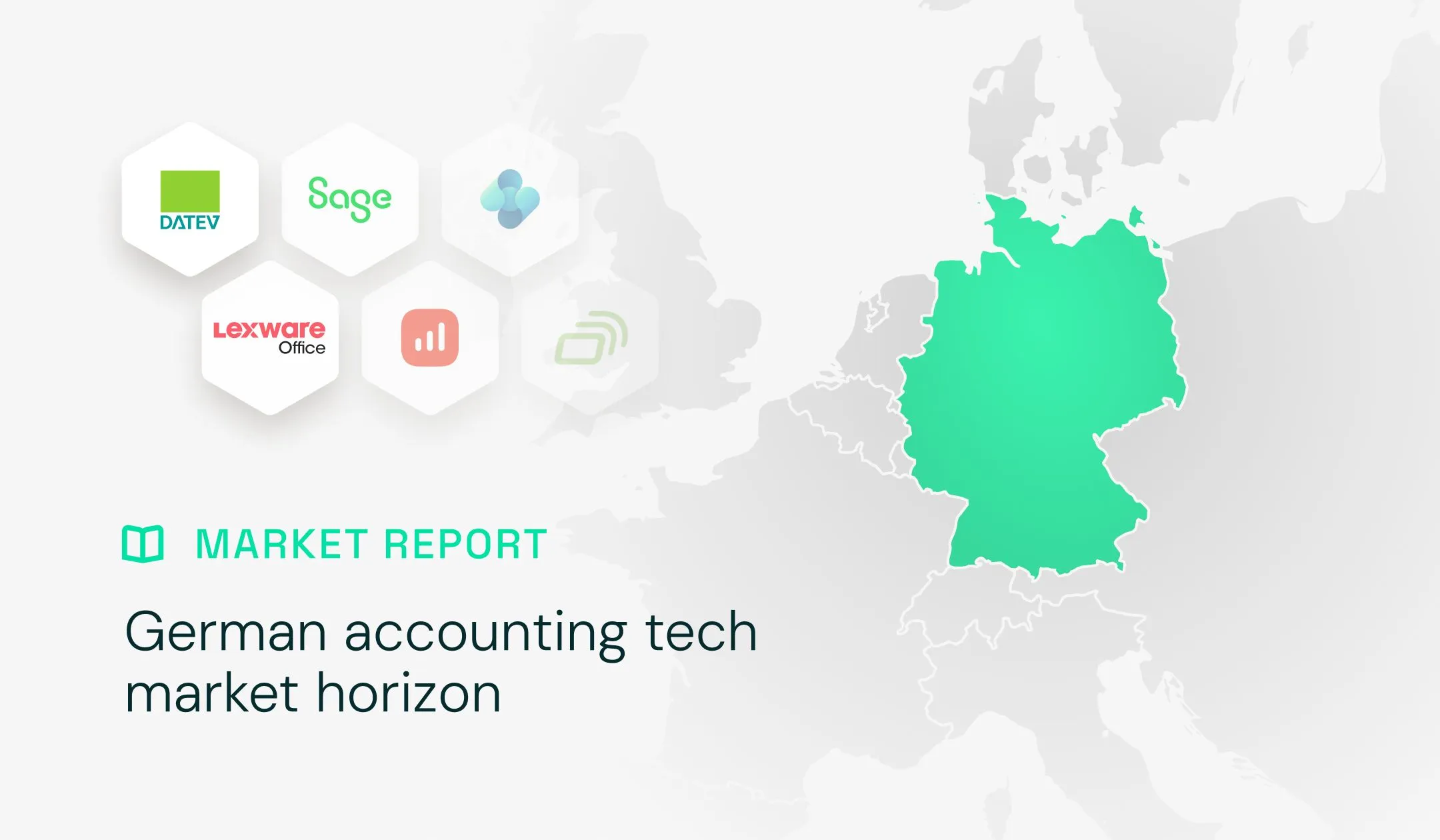
- DATEV is the dominant accountant suite, with no close equivalent in any other country in our panel. Its 47% share in our survey almost certainly understates its true footprint. Because most German SMEs never interact directly with the software their Steuerberater uses, DATEV is structurally under-reported in any SME-facing survey. In reality, it's the de facto operating system of German accounting.
- Lexware Office and sevdesk serve SMEs managing accounting more directly, with sevdesk showing strong visibility in the cloud-native SME segment.
- The mid-market layer is shaped by ERP finance systems such as Microsoft Dynamics.
The SME layer is almost entirely cloud-based (Lexware Office, sevdesk, FastBill, Weclapp), while DATEV itself offers both on-premise and cloud deployment, with the on-premise version still widely used by accountants.
What this means for software vendors
Read DATEV's 47% as a floor, not a ceiling. Its real penetration among accountants is significantly higher than survey data captures, simply because SMEs don't report the tool their accountant uses on their behalf. Two further accountant suites barely show up in SME data but matter in the accountant channel: ADDISON (Wolters Kluwer) and Agenda, both alternatives to DATEV.
For a SaaS vendor, the practical implication is that German coverage starts with deep DATEV connectivity, then extends to the cloud SME tools (sevdesk, Lexware Office) and the ERP layer. That's a demanding integration roadmap, and one where API maintenance and authentication quirks can eat your engineering time.
This is exactly what Chift handles for you. One integration gives you access to a growing library of German and European accounting connectors, with authentication, mapping and ongoing maintenance taken care of.
Get the full picture
Germany is one of ten countries we analysed in depth. The full State of European Accounting Tech 2026 report covers Belgium, France, Spain, the Netherlands, the UK, Italy, Denmark, Sweden and Norway, plus the trends reshaping SME software, how businesses choose their tools, and why integration has become the defining battleground for accounting platforms.
Download the full white paper to get the complete market landscape, all the data, and the country-by-country breakdown.
Want to see how Chift can connect your product to Europe's accounting software? Book a demo with our team.
.webp)