The Netherlands is one of Europe's most digitally advanced accounting markets. It's also one of the most fragmented. Dutch businesses don't standardise on one tool, they mix best-of-breed software for invoicing, expenses and payroll around a core platform. For a SaaS vendor or fintech, that fragmentation is both the opportunity and the challenge: connectivity here isn't a nice-to-have, it's a practical necessity.
This guide pulls the Netherlands findings from our State of European Accounting Tech 2026 study, based on a survey of 1,400 SMEs and accountants across Europe, including 100 respondents in the Netherlands.
The Netherlands at a glance
- 1.5M SMEs
- 15 accounting tools named by Dutch respondents
- B2B e-invoicing mandate: not mandatory (B2G is established)
- 100 survey respondents
Dutch SMEs frequently manage day-to-day bookkeeping in-house, while accountants typically support compliance and advisory rather than running the books end to end.
"The Netherlands stands out for its highly fragmented software landscape, where both SMEs and accounting firms operate across multiple tools. It's common for accounting firms to use several bookkeeping systems simultaneously, depending on client segments, but also as a way to diversify risk."— Arjan Van Brakel, founder
What's the role of accountants in the Netherlands?
Accountants matter, but their influence is more pronounced for larger companies. Many Dutch entrepreneurs start independently and only bring in an accountant later, for compliance, annual accounts and advisory services.
"Unlike in other European markets, Dutch entrepreneurs often start without an accountant and only bring one in when administration becomes a burden. This positions accountants primarily as compliance partners, rather than as trusted advisors from day one."— Arjan Van Brakel, founder
That's a meaningful difference from accountant-led markets like Germany or France. In the Netherlands, the business owner is often the one choosing and operating the software, especially early on.
A market anchored by two platforms and a long tail
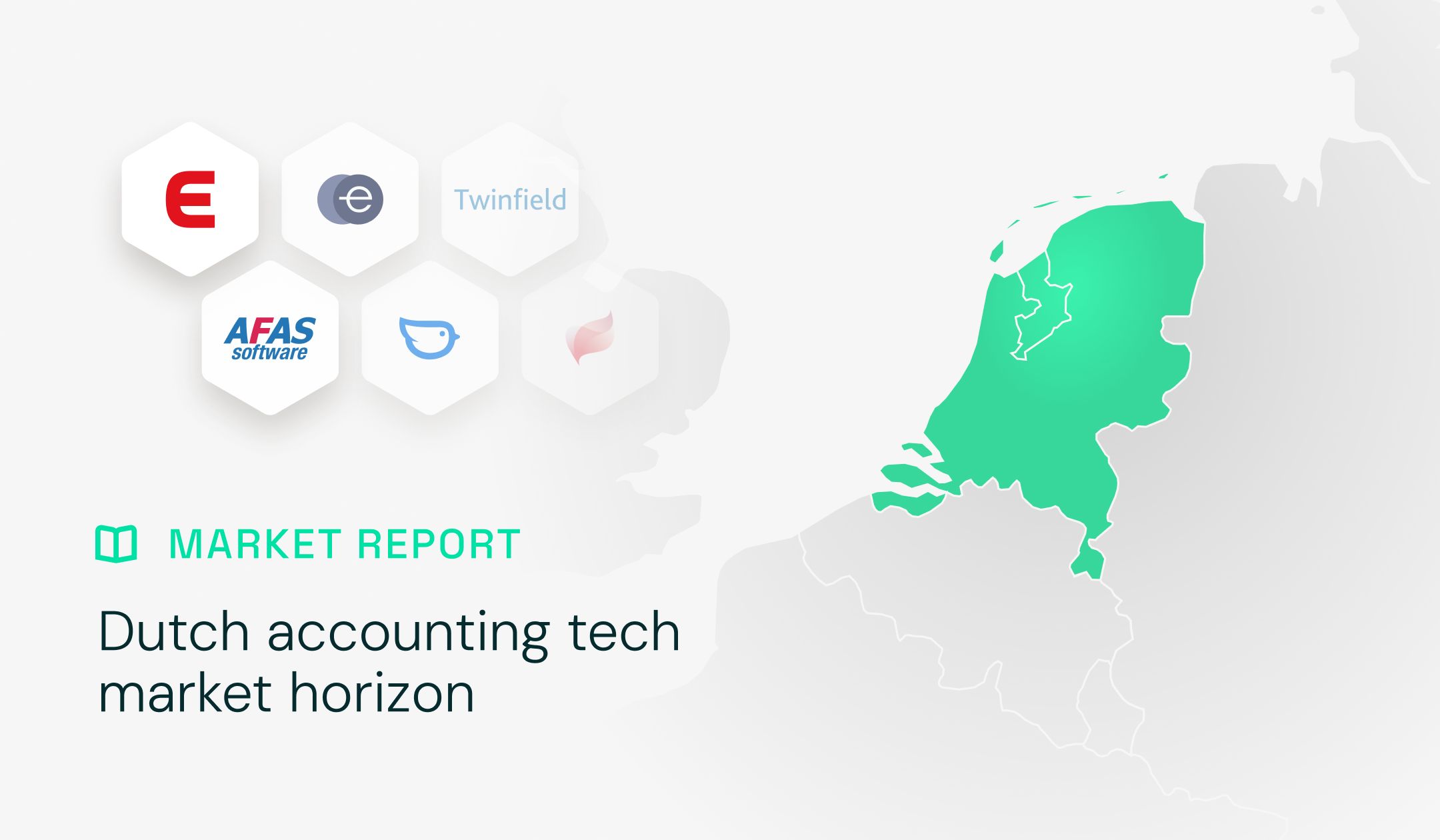
The Dutch market is anchored by two dominant platforms, followed by a diverse long tail of SME tools and accountant software. Exact Online and AFAS together account for the majority of multi-tool pairings in our data.
The landscape breaks down into three groups:
- SME tools (E-boekhouden, Moneybird) serve businesses managing accounting directly.
- Accountant software (Exact Online, Yuki, Twinfield, Minox, Visma AccountView, King Software) is used by firms managing multiple client portfolios.
- Shared tools are used by both entrepreneurs and their accountant.
Externally, this top tier is very consistent with how the Dutch market is described: Exact Online and AFAS are widely seen as leaders, and Twinfield is often cited as a key accounting platform. AFAS may be somewhat overstated relative to the broader SME market, given the mid-market composition of the sample.
What this means for software vendors
Fragmentation in the Netherlands is driven by a culture of best-of-breed adoption. Companies combine a core accounting platform with separate tools for invoicing, expenses and payroll, which makes connectivity between systems a practical necessity rather than an optional feature.
For a vendor, that has a clear consequence. You can't reach the Dutch market by integrating with one platform. You need Exact Online and AFAS at the top, plus credible coverage of the long tail (Twinfield, Yuki, Moneybird, Minox and more). Our survey captures that long tail directionally, but the real breadth is even wider, with tools like InformerOnline, Jortt, Cash and Silvasoft sitting just outside the sample.
Building and maintaining that many integrations in-house is exactly the problem Chift is built to solve. One integration gives you access to a growing library of Dutch and European accounting connectors, with authentication, mapping and API maintenance handled for you.
Get the full picture
The Netherlands is one of ten countries we analysed in depth. The full State of European Accounting Tech 2026 report covers Belgium, France, Spain, Germany, the UK, Italy, Denmark, Sweden and Norway, plus the trends reshaping SME software, how businesses choose their tools, and why integration has become the defining battleground for accounting platforms.
Download the full white paper to get the complete market landscape, all the data, and the country-by-country breakdown.
Want to see how Chift can connect your product to Europe's accounting software? Book a demo with our team.
.webp)