If you build or integrate SaaS products, you will eventually encounter REST, SOAP, or GraphQL.
They are not competing tools in the traditional sense. They are different architectural approaches to designing APIs, the rules that define how systems exchange data.
Choosing between them is not just a technical preference. It affects scalability, performance, integration complexity, and long-term maintenance.
Let’s clarify what each one is, how they differ, and where they make sense in modern SaaS environments.
What is an API in practical terms?
An API (Application Programming Interface) defines how two systems communicate.
For example:
- A POS system sends daily sales data to accounting software
- An HR platform pulls employee records from payroll software
- A SaaS analytics tool retrieves transactions from an e-commerce platform
The API defines the structure of requests, how responses are formatted, and how errors are handled.
REST, SOAP, and GraphQL are three different ways to design that communication layer.
What is REST?
REST (Representational State Transfer) is the most widely adopted API architecture today.
It is built around:
- Standard HTTP methods (GET, POST, PUT, DELETE)
- Resource-based URLs
- JSON as the common data format
- Stateless communication
Each request contains all the information needed to process it. The server does not store session state between calls.
REST is popular because it is simple, flexible, and well-aligned with how the web works.
Common use cases of REST
- Web and mobile applications
- SaaS integrations
- Data retrieval and updates
- Scalable, distributed systems
Most modern accounting platforms, POS systems, CRMs, and e-commerce tools expose REST APIs.
Example in practice
A SaaS accounting tool retrieving daily sales from a POS platform may send:
GET /sales?date=2025-01-10
The system responds with structured JSON, which can then be reconciled against ledger entries.
REST prioritizes clarity, compatibility, and scalability.
Read our blog for an in-depth overview on “What is a REST API and what are its advantages?”
What is SOAP?
SOAP (Simple Object Access Protocol) is a more rigid, protocol-driven API standard.
Unlike REST, SOAP:
- Uses XML strictly
- Enforces formal messaging structures
- Often relies on WSDL contracts
- Includes built-in security and transaction standards
SOAP was designed for enterprise-grade reliability, especially in environments where strict contracts and transactional guarantees matter.
Where SOAP is still relevant
- Banking systems
- Government services
- Enterprise ERP platforms
- Legacy financial infrastructure
It provides strong standardization and security, but it is heavier to implement and maintain.
Example in practice
A bank transferring regulated financial records between internal systems may rely on SOAP because it enforces strict validation rules and supports transactional guarantees.
However, development cycles tend to be longer compared to REST-based systems.
What is GraphQL?
GraphQL is a query-based API architecture introduced to solve inefficiencies in traditional REST APIs. Instead of calling predefined endpoints that return fixed data structures, GraphQL allows clients to specify exactly what data they want.
This means:
- One endpoint
- Customizable queries
- Flexible response shapes
The client controls the structure of the returned data.
GraphQL common use cases
- Complex front-end applications
- Data-heavy dashboards
- Mobile apps requiring optimized payloads
- Systems with many related data objects
It reduces over-fetching and under-fetching by allowing precise queries.
Example in practice
A reporting dashboard may request:
{
sales(date: "2025-01-10") {
total
vat
paymentMethod
}
}
Only the specified fields are returned, reducing unnecessary data transfer.
GraphQL prioritizes precision and efficiency in data retrieval.
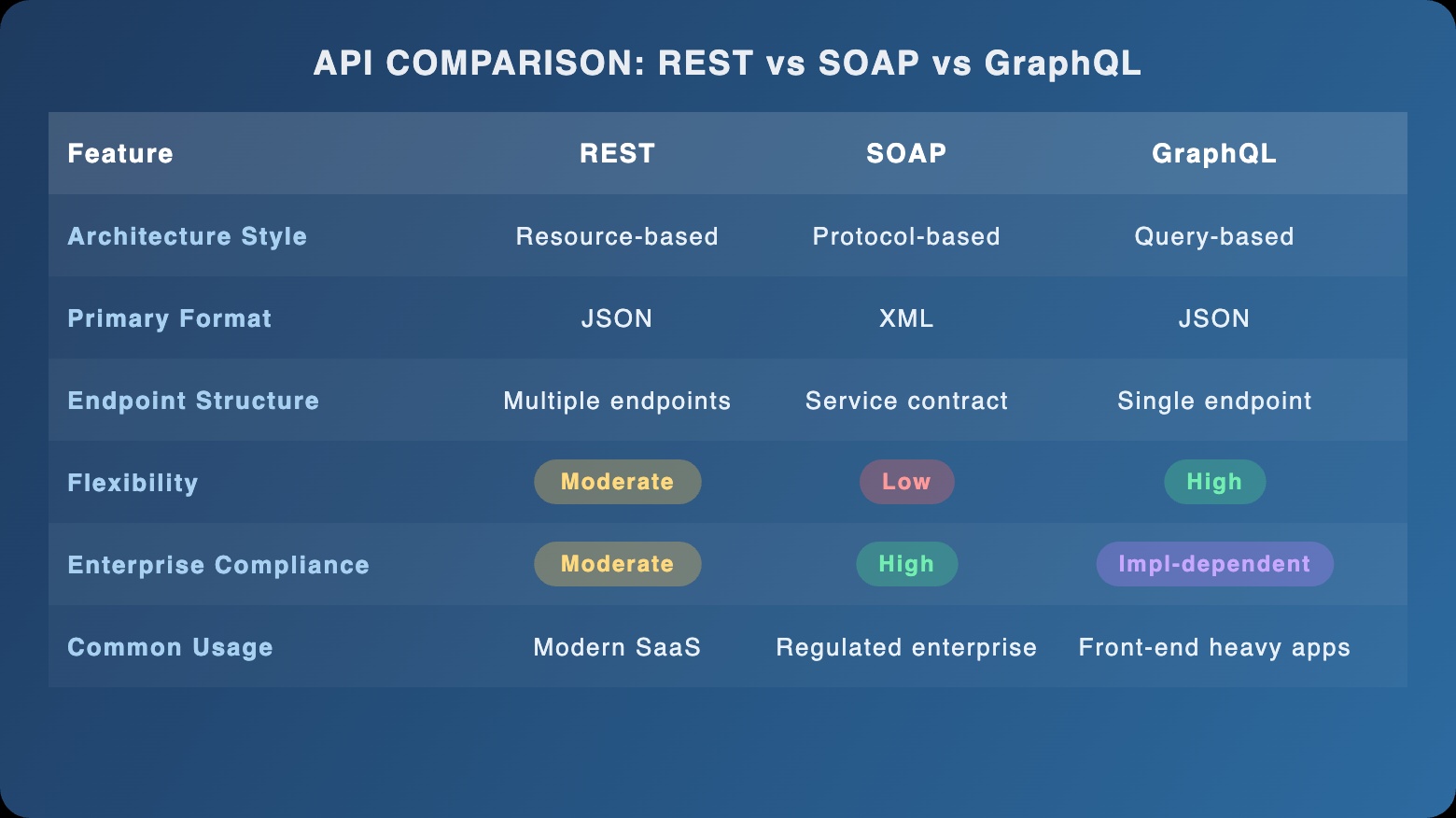
Key differences between REST, SOAP, and GraphQL
Communication model
- REST uses stateless HTTP request-response interactions.
- SOAP uses XML-based message envelopes and can operate over multiple transport protocols.
- GraphQL typically operates over HTTP but centralizes all operations under a single endpoint.
Data structure and format
- REST commonly uses JSON.
- SOAP strictly uses XML.
- GraphQL responses are JSON, defined by a strongly typed schema.
Flexibility and efficiency
REST provides structured endpoints but may return more data than needed.
SOAP is tightly coupled to predefined service contracts and is less flexible by design.
GraphQL allows clients to request only required fields, reducing over-fetching and improving efficiency in complex applications.
Error handling
REST communicates errors using HTTP status codes.
SOAP includes structured fault messages within XML responses.
GraphQL embeds error details within the response body alongside data.
Security considerations
REST typically relies on HTTPS and external authentication standards such as OAuth.
SOAP includes WS-Security standards for message-level protection.
GraphQL relies on HTTPS and must implement careful authorization controls, especially for nested queries.
Comparison Table
Implications for integration-heavy SaaS platforms
For SaaS companies operating in fragmented ecosystems such as accounting, POS, or e-commerce, REST is currently the dominant model. Most modern platforms expose REST APIs because they balance flexibility and implementation simplicity.
However, legacy systems may still rely on SOAP, particularly in financial and government contexts. GraphQL becomes relevant when products require highly dynamic front-end queries or optimized payload control.
In practice, integration-focused platforms often need to support multiple API styles simultaneously. This adds architectural complexity, especially when normalizing data across systems built on different standards.
That is where abstraction layers such as unified APIs become strategically useful. They absorb differences between REST, SOAP, and other architectures, allowing SaaS vendors to build against a consistent interface while supporting diverse ecosystems underneath.
Bottom Line: Which API style should you choose?
The answer depends on your context.
If you are building a modern SaaS product that integrates with third-party platforms, REST is typically the most practical and widely supported option.
If you operate in a highly regulated enterprise environment requiring strict contracts and transactional guarantees, SOAP may still be appropriate.
If your application requires flexible data querying and front-end efficiency, GraphQL may provide advantages.
The important consideration is not which one is “better,” but which aligns with your integration model, scalability needs, and long-term architecture.
FAQs
1. Is REST more secure than SOAP?
Security depends on implementation, not architecture alone. SOAP includes built-in standards for security and transactions, while REST typically relies on HTTPS and external authentication mechanisms such as OAuth.
2.Why do banks still use SOAP?
Banks and regulated institutions often require strict contracts, transactional guarantees, and XML-based validation standards. SOAP provides formal messaging rules that align with those compliance requirements.
3.Can GraphQL replace REST entirely?
GraphQL can replace REST in certain applications, especially those requiring flexible data queries. However, many systems continue to use REST for simplicity, caching advantages, and compatibility with existing infrastructure.
4.Which API style is easier for developers?
REST is generally considered easier to implement and maintain due to its simplicity and alignment with HTTP standards. SOAP requires more structured setup, while GraphQL requires schema design and query management.
5.How does Chift handle different API architectures?
Chift focuses on standardizing access to financial ecosystems such as accounting and POS systems across Europe. Regardless of the underlying API style, Chift abstracts complexity into a unified model, allowing SaaS vendors to integrate once and scale without managing architectural differences directly.
.webp)
.jpg)