.jpg)
SumUp is a leading POS and payment technology company used by millions of merchants across Europe and beyond to accept card payments in-store and online. For software companies serving SMB merchants, a SumUp integration unlocks powerful financial data flows directly inside your product.
Integrating with the SumUp API allows you to:
- Automatically retrieve transaction and payout data for reconciliation or reporting
- Access merchant and customer information to power financial workflows
- Sync payment data with accounting software for automated bookkeeping
- Build lending or cash flow tools on top of real sales data
This guide covers everything you need to know about the SumUp API, including technical setup, best practices, and how Chift's Unified POS API helps you skip the heavy lifting.
What is the SumUp API?
SumUp exposes several distinct API surfaces, all REST-based. At Chift, we use the Core REST API, which powers our SumUp connector and covers the main transactional and merchant data flows.
The API communicates via JSON over standard HTTP, using resource-oriented URLs and conventional HTTP status codes. The base URL is https://api.sumup.com.
The main resource groups available through the API include:
- Transactions: individual card payment records
- Payouts: settlement data sent to merchant bank accounts
- Checkouts: online payment sessions
- Customers: stored customer profiles
- Receipts: digital receipt data
- Readers: card terminal (hardware) management
- Merchants: merchant account and profile data
- Members, Memberships, Roles: user and access management
- Subaccounts: multi-location merchant structures
At Chift, we primarily use the SumUp API to read transactions, payouts, and merchant data, the three data types that power most payment-to-accounting and payment-to-fintech use cases.
Authentication is handled via OAuth2. To connect, the client must provide a Client ID and Client Secret, which are used to obtain access tokens for API calls.
For full technical reference, consult the SumUp API documentation.
{{CTA-1}}
Examples of SumUp API integration use cases
Automated transaction reconciliation for accounting platforms
Accounting and pre-accounting solutions can pull SumUp transaction data through Chift to automatically reconcile card payments with invoices or journal entries. This eliminates manual CSV exports and significantly reduces end-of-day admin for merchants and their accountants.
.jpg)
Cash flow visibility for financial management tools
Cash flow management and financial forecasting tools can use SumUp payout data to give merchants a real-time view of incoming funds. Instead of waiting for bank statements, your product can show what's been processed, what's been settled, and what's pending, all in one place.
.jpg)
Transaction data for business lending platforms
Business lenders and fintech platforms can use SumUp transaction history to assess merchant revenue, identify trends, and make data-driven credit decisions. Real sales data from a card reader is among the most reliable signals of business health, making SumUp a valuable source for embedded lending workflows.
.jpg)
For more examples of how payments integrations can improve your product, explore our Chift case studies.
Setting up your SumUp API integration
To connect to the SumUp API, you'll need to set up an OAuth2 application and obtain credentials from the SumUp developer portal.
Here's how to get started:
- Create a developer account at developer.sumup.com.
- Register your application to receive a Client ID and Client Secret.
- Implement the OAuth2 authorization flow to obtain access tokens on behalf of your merchants.
- Use the access token in the
Authorization: Bearerheader on each API request. - Handle token refresh logic to maintain persistent access without requiring re-authentication.
While the SumUp API is well-documented and accessible, production-grade integrations require more than a basic connection. You'll need to handle token lifecycle management, data normalization across merchants, multi-tenant architectures, error handling, and ongoing API maintenance, especially as SumUp evolves its endpoints over time.
Best practices for SumUp API integration
- Use the versioned, non-deprecated endpoints. SumUp exposes both current and deprecated versions for transactions and payouts (e.g.
/api/transactions/listvs./api/transactions/list-deprecated). Always use the non-deprecated paths, they return richer data and will remain supported going forward. - Store credentials securely. API keys and OAuth credentials should be stored in environment variables, never hardcoded in your application. The SumUp SDK loads credentials from the
SUMUP_API_KEYenvironment variable by default. Never expose keys in client-side code, public repositories, or browser environments. - Implement exponential backoff for rate limit errors. SumUp does not publish specific numeric rate limits, but the API returns
429 Too Many Requestswhen limits are exceeded. Build retry logic using exponential backoff to handle these gracefully without flooding the API. - Normalize merchant data from the start. Merchant data models can vary across subaccounts and integration contexts. Standardize your internal data model early to avoid inconsistencies downstream, especially if you're connecting multiple merchants through the same pipeline.
- Scope OAuth permissions carefully. Request only the OAuth scopes your integration actually needs. Limiting access reduces security risk and keeps your application in line with least-privilege principles.
Why integrate with SumUp through Chift?
Building a direct SumUp integration is straightforward to start. But once you've handled OAuth2 token refresh logic, pagination, rate limit retries, multi-merchant data normalization, and the inevitable endpoint deprecations, you still need to maintain all of that as the API evolves. And then do the same for every other payment tool on your roadmap.
With Chift's Unified Payments API, you integrate once and get access to SumUp, Stripe, Mollie, Square, MyPOS, and many more, all through the same normalized data model.
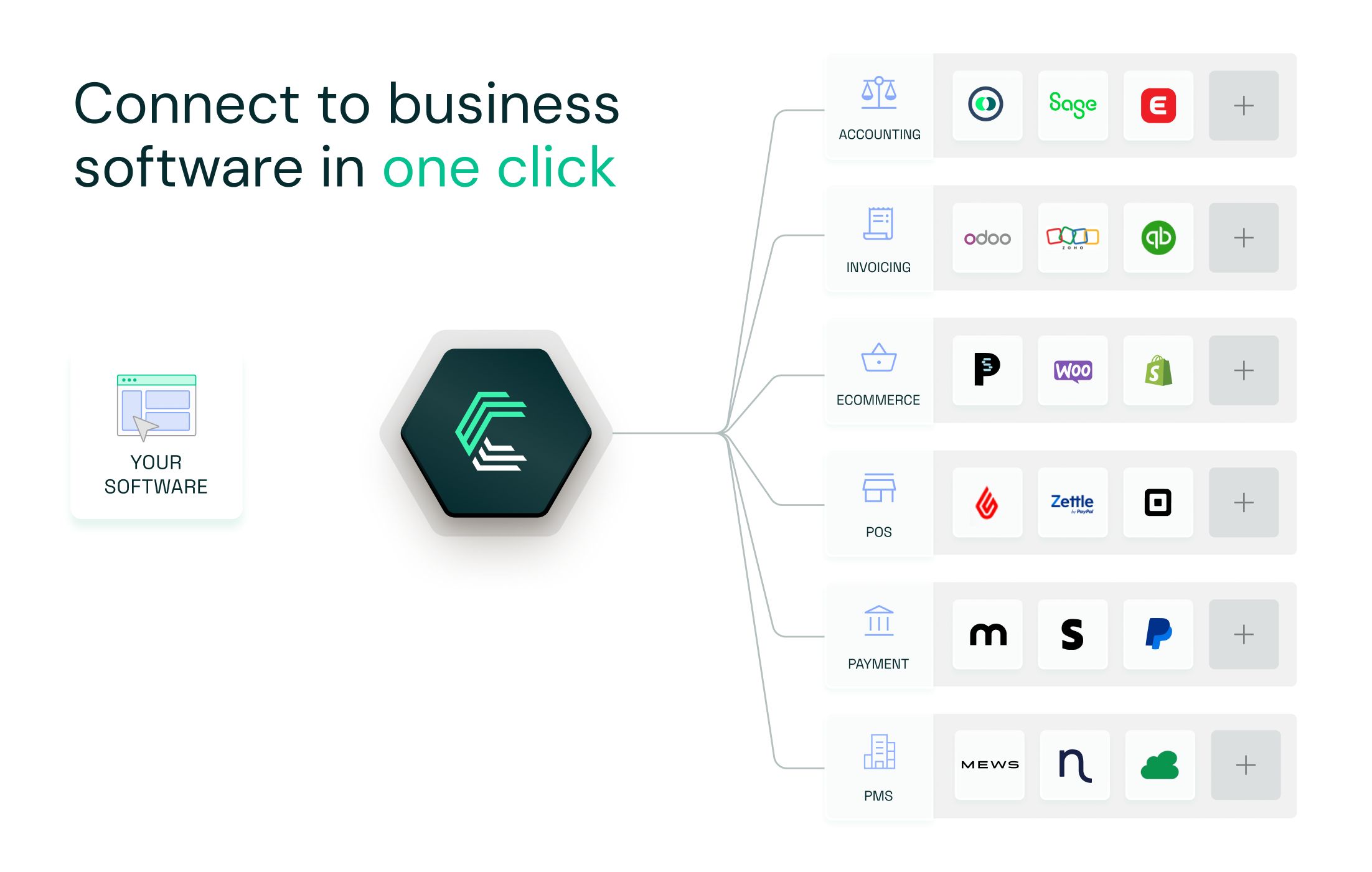
Here's what that unlocks for your team:
- Your engineering team builds one integration, then stays focused on your core product
- New connectors activate in one click, with no additional development work required
- Authentication, error handling, and data mapping are fully managed by Chift
- Built-in monitoring, logging, and long-term maintenance included
- Expert support from a team that understands both the technical and business sides of financial integrations
Your dev team saves time. Your sales team can say yes to more integration requests. And your product becomes the default choice for customers who need their payment data to flow.
Want to see how Chift connects your product to SumUp and 50+ other financial tools? Get in touch with our team to discover more.
SumUp API FAQ
What endpoints are included in the SumUp API via Chift?
Chift's SumUp connector exposes a standardized set of endpoints covering the most important payment data, including (but not limited to):
- Transactions
/transactions - Payouts
/payouts - Merchants
/merchants
Consult our SumUp API documentation for a full list of available routes.
What are the SumUp API rate limits?
SumUp does not publish specific numeric rate limits in its official documentation. The API returns 429 Too Many Requests when limits are exceeded. The recommended handling is to implement retry logic with exponential backoff, increase the delay between retries progressively rather than hammering the endpoint immediately after a rejection.
Which payment API is free?
SumUp's API has no access or subscription fee, you pay only per transaction processed. Among payment APIs generally, Stripe, Square, and PayPal follow the same model. Truly free payment APIs (zero transaction fee) don't exist for commercial card processing, as interchange fees always need to be covered. Some open banking and bank transfer APIs, like GoCardless, can offer very low rates as an alternative for certain use cases.
Who is SumUp owned by?
SumUp is a privately owned fintech company backed by its founders and a consortium of global institutional investors.
What country is SumUp from?
SumUp is a British financial technology company headquartered in London, with a strong presence across Europe and international markets.
What percent does SumUp take?
For in-person payments, SumUp's standard transaction fee is 1.69%. For online payments (payment links, bookings, digital products), the fee is 2.50% per transaction. With the Payments Plus subscription (£19/month), the in-person rate drops to 0.99% for domestic consumer cards (international, corporate, and AMEX cards remain at 1.69%). There are no setup fees, monthly fees on the standard plan, or charges for declined transactions. See SumUp's pricing page for full details.
Can you integrate SumUp with Shopify?
Yes, but not natively out of the box, it requires a third-party bridge. SumUp and Shopify do not have a direct native integration, so connecting the two typically involves a middleware layer or third-party connector.
Can SumUp integrate with other apps?
Yes. SumUp allows third parties to integrate its end-to-end payment infrastructure via its developer API, enabling a wide range of integrations across accounting, ERP, CRM, and fintech tools.
What accounting software works with SumUp?
SumUp has an official partnership with Xero, enabling merchants to sync their sales history at no additional cost (SumUp One subscribers also get an exclusive 90% discount on their first six months of Xero). SumUp POS also integrates with QuickBooks, allowing users to sync sales data for VAT returns and financial reporting directly from their dashboard. For broader accounting connectivity across other platforms, Chift's Unified Payments API can bridge SumUp data to additional accounting tools.





.jpg)
.jpg)
.jpg)
.jpg)

.jpg)
.webp)
.webp)

.jpg)
.jpg)



.webp)
.jpg)
.webp)








.avif)


