Odoo is a flexible and widely adopted business management platform, bringing together CRM, ERP, e-commerce, accounting, inventory, payroll, project management, and more into a single, integrated suite. This modular yet unified system is used by millions of businesses worldwide to streamline operations and centralize data flows.
In this article, we explore Odoo’s product offering, its core capabilities, and the role of Chift as an integration connector that enables seamless connections between Odoo and external systems making data exchange simpler, more reliable, and scalable for buisnesses.
What is Odoo? Product overview
Odoo is a comprehensive business management software platform, now used globally by small to large enterprises. It combines a wide range of business applications on one platform, designed to work together natively so that users can manage multiple processes from one system.
At its core, Odoo’s approach is modular and integrated:
- Businesses can select only the apps they need, from CRM and sales to inventory and accounting, and expand over time.
- Modules share the same underlying data model, reducing duplication and enabling real-time insights across departments.
- Odoo is offered in two editions: an open-source Community edition and an Enterprise edition with advanced features and official support.
Connect to all popular solutions with a single integration
Discover how Chift's Unified APIs have helped software vendors quickly add dozens of integrations.
Key features and core capabilities
A truly modular ERP suite
Odoo’s platform consists of a suite of apps each handling specific business functions. Some of the most widely used include:
- CRM & Sales Management: manage leads, pipelines, orders, and quotations.
- Accounting & Finance: support for billing, financial reporting, taxes, and multi-currency operations.
- Inventory & Warehouse: real-time stock tracking, multi-warehouse support, fulfillment workflows.
- Project Management: tasks, planning, time tracking, and resource allocation.
- E-commerce & Website Builder: built-in web CMS and online store capabilities.
- Human Resources & Payroll: recruitment, attendance, payroll processing.
This modular architecture allows companies to adopt what they need now while leaving room to grow later.
Deep dive: Accounting, Invoicing, and POS in Odoo
Odoo Accounting: the core financial engine
Odoo Accounting acts as the central financial backbone of the platform. It automatically aggregates data coming from invoicing, POS, sales, and payments into a unified accounting system. All of daily and yearly accounting activities can be managed through one single platform.
Key capabilities include:
- Automated journal entries generated from invoices and POS transactions
- Accounts receivable and payable management
- Tax configuration and fiscal positions
- Multi-currency accounting and exchange rate handling
- Financial statements such as balance sheets and profit & loss reports
Whether you are an accountant managing your client’s accounting or you are handling your own accounting, Odoo Accounting is the module that answers your need.
Odoo Invoicing: from transactions to revenue
Odoo Invoicing can be used independently or as part of the accounting suite. It is responsible for transforming sales activity into formal financial documents.
Core invoicing features include:
- Customer invoices and supplier bills
- Recurring invoices and subscription billing
- Credit notes, refunds, and adjustments
- Payment reconciliation and follow-ups
- Integration with multiple payment providers
Invoicing often sits at the crossroads of several systems, such as CRM, subscription platforms, or billing tools.
Odoo Point of Sale (POS): bridging physical sales and accounting
Odoo POS is designed for retail and hospitality environments, supporting high-volume, real-time transactions with both online and offline capabilities.
Key POS functionalities include:
- Fast checkout with offline support
- Multiple payment methods and cash management
- Real-time inventory updates
- Automatic creation of invoices and accounting entries
- Multi-store and multi-user setups
Overview of Odoo Enterprise Applications
In addition to its core financial and transactional modules, Odoo Enterprise includes a wide range of applications designed to cover end-to-end business operations. These apps build on the Community edition and add advanced features, scalability, and enterprise-grade tooling.
Below is an overview of the main Odoo Enterprise applications, grouped by business domain.
Sales, Marketing & Customer Experience
- CRM
- Sales
- Subscriptions
- Rental
- Marketing Automation
- Email Marketing
- SMS Marketing
- Social Marketing
- Events
- Appointments
- Live Chat
- Helpdesk
- eLearning
Finance & Accounting
- Accounting
- Invoicing
- Expenses
- Documents
- Spreadsheet (BI)
- Sign
Retail, Commerce & Point of Sale
- Point of Sale
- eCommerce
- Website
- Loyalty Programs (POS)
- Blog
- Forum
- Surveys
Inventory, Manufacturing & Operations
- Inventory
- Purchase
- Manufacturing (MRP)
- Maintenance
- Quality
- PLM (Product Lifecycle Management)
- AI
- ESG
Human Resources
- Employees
- Recruitment
- Time Off
- Appraisals
- Referrals
- Fleet
Project Management & Services
- Project
- Timesheets
- Field Service
- Planning
Productivity & Collaboration
- Approvals
- VoIP
- Knowledge
- Discuss
Building an API integration with Odoo
Odoo’s ecosystem offers significant opportunities thanks to its modular ERP approach and wide adoption across industries. However, integrating with Odoo also comes with technical and operational challenges that require the right strategy and tooling. If you are a software vendor looking to connect your solution to Odoo, here are the key points to consider.
SaaS, on-premise, and hybrid deployments
Odoo is available in multiple deployment models: Odoo Online (SaaS), Odoo.sh, and on-premise installations. While cloud deployments make integrations more accessible through APIs, a large number of businesses still rely on self-hosted or customized on-premise versions.
These environments can differ significantly in configuration, versioning, and data models, making integrations harder to standardize and maintain. Chift addresses this complexity by providing a unified API layer, allowing software vendors to integrate with Odoo regardless of deployment type, while abstracting the underlying technical differences.
Multiple versions, modules, and customizations: high development and maintenance costs
Odoo exists in:
- Multiple major versions
- Community and Enterprise editions
- Highly customized implementations with custom modules and fields
For a software vendor, “integrating with Odoo” often means handling a wide range of configurations and edge cases. Initial development is only part of the effort: long-term maintenance quickly becomes the real cost, especially when Odoo versions evolve or when clients upgrade their systems.
Chift simplifies this by offering a single, standardized integration. Instead of maintaining multiple Odoo-specific connections, software vendors can rely on Chift’s unified API, which handles version changes and connector updates centrally. New Odoo connectors or improvements can be activated directly from Chift’s back-office, ensuring scalability and long-term reliability.
Understanding Odoo’s functional complexity
To build a meaningful integration, software vendors need a solid understanding of the connected product. Odoo covers a broad range of business functions, accounting, invoicing, sales, inventory, CRM, projects, and more, each with its own logic and dependencies.
Navigating this functional richness can be challenging, especially for teams that are not Odoo specialists. Chift supports software vendors with clear, structured documentation and standardized data models, making it easier to understand how Odoo objects (such as invoices, customers, or products) are handled during synchronization. This significantly reduces onboarding friction for both vendors and end users.
Odoo’s partner-driven ecosystem
Odoo relies heavily on a global network of integrators and implementation partners. These partners play a central role in deploying, configuring, and maintaining Odoo instances for end customers. For software vendors, this means that integrations are often implemented or configured by partners rather than directly by the end users.
This model creates opportunities but also requires close collaboration with integrators. Chift facilitates this collaboration by enabling ISVs, integrators, and SMEs to work together seamlessly during connector setup and activation. Integrators can easily deploy integrations for their clients without complex technical prerequisites, accelerating adoption within the Odoo ecosystem.
Chift: your strategic ally for integrating with Odoo
Navigating the Odoo ecosystem can be demanding for software vendors, but the opportunities it unlocks are substantial. To connect your solution to Odoo and meet your users’ expectations, it is essential to overcome technical complexity while delivering a seamless integration experience.
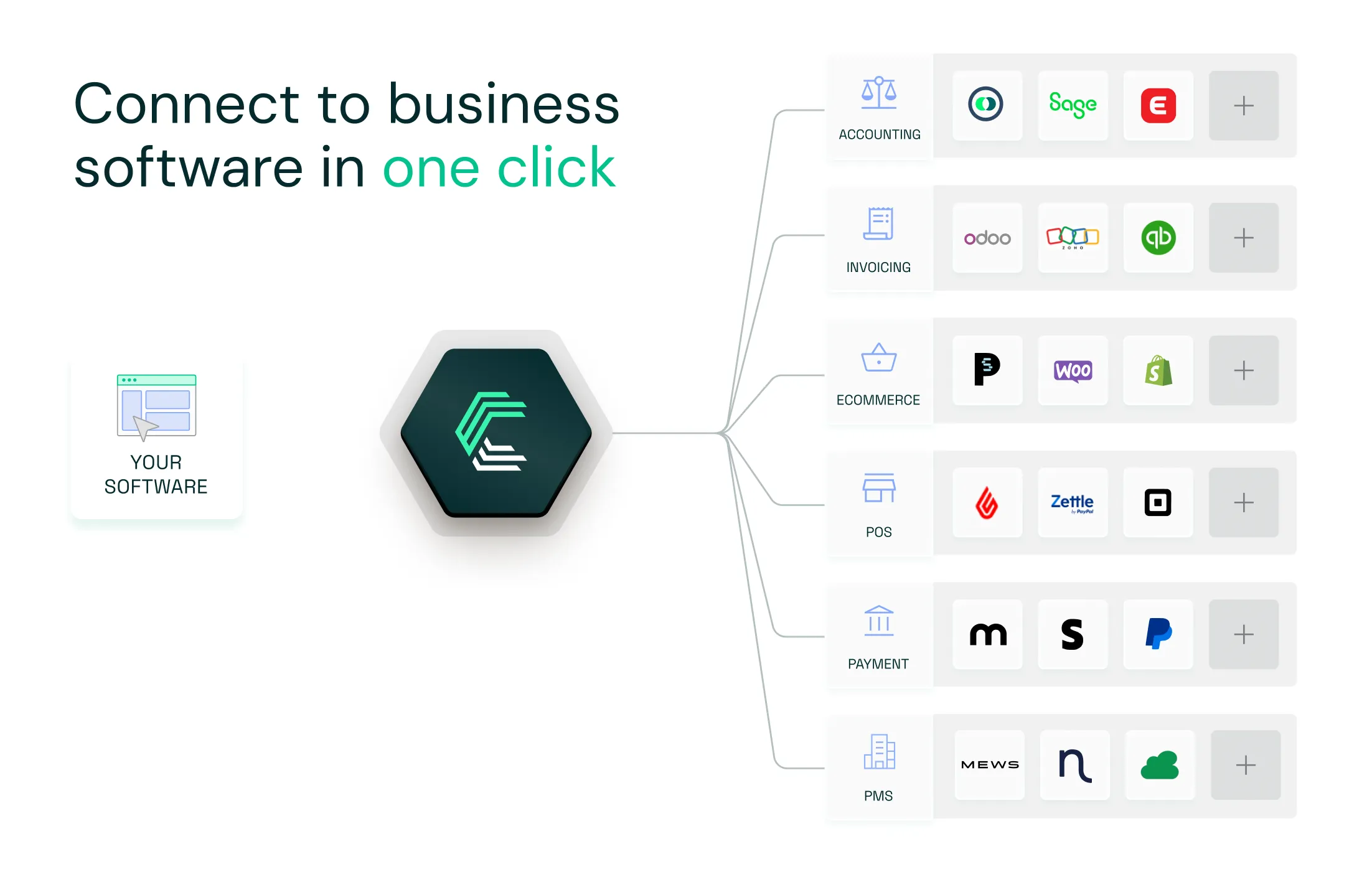
With Chift, this challenge becomes an opportunity. Thanks to its unified API, a single integration provides access to Odoo and other key business tools, reducing development effort and significantly accelerating time-to-market.
What truly sets Chift apart is its deep understanding of ERP and accounting ecosystems. By continuously adapting its connectors and abstractions, Chift enables software vendors to stay aligned with Odoo’s evolution while focusing on what matters most: building value for their users.
In short, integrating with Odoo has never been easier. With Chift, you can scale faster, reduce technical overhead, and unlock new opportunities within the Odoo ecosystem.
What Chift enables with Odoo API integrations
Beyond describing Odoo as a modular ERP platform, it can be useful to detail how Chift enhances Odoo connectivity for your product and users. With Chift’s unified API layer, you can offer ready-made connectors that simplify and accelerate integration between Odoo and external systems, so your customers don’t have to build and maintain these integrations themselves.
Chift currently supports the following Odoo-focused connectors:
- Odoo Accounting: Synchronize core financial data such as general ledger entries, invoices, payments, and balances directly between Odoo and your application, enabling automated bookkeeping workflows.
- Odoo Invoicing: Connect the invoicing module of Odoo so that sales invoices, credits, billing events and related statuses can be seamlessly exchanged, reducing manual billing and reconciliation tasks.
- Odoo POS: Support point-of-sale data flow, so transactions, payments and shift information from Odoo’s POS module can be synchronized with other systems in real time.
These connectors are available through Chift’s unified APIs, which means one integration on your side provides access to multiple endpoints and data flows with minimal engineering effort.
Curious about how Chift can help you integrate with Odoo? Check out our API guide for Odoo.
.webp)