Les agents IA transforment la façon dont les logiciels interagissent avec les systèmes financiers. Au lieu d'intégrations rigides et prédéfinies, les agents peuvent raisonner sur les données, s'adapter au contexte et exécuter des workflows en plusieurs étapes à travers les plateformes de comptabilité, de paiement et de caisse.
Mais construire des intégrations pilotées par des agents à partir de zéro suppose de résoudre des problèmes complexes : l'authentification sur des dizaines de systèmes, la normalisation des données entre différents modèles comptables, la fiabilité de la synchronisation en temps réel et la conformité aux réglementations financières locales.
C'est là que les plateformes d'intégration pour agents IA deviennent une infrastructure indispensable. Cet article explique ce que font ces plateformes, pourquoi elles comptent pour les workflows financiers et comment les évaluer pour votre produit.
Qu'est-ce qu'une plateforme d'intégration pour agents IA ?
Une plateforme d'intégration pour agents IA fournit la couche d'infrastructure qui permet aux agents IA de se connecter à des systèmes externes, d'y lire et d'y écrire des données. Plutôt que de faire construire et maintenir par vos équipes chaque connexion API, la plateforme masque cette complexité derrière une interface unifiée avec laquelle les agents interagissent.
Pour les données financières, cela signifie concrètement :
- un accès standardisé aux logiciels de comptabilité (Pennylane, Sage, QuickBooks, Xero) ;
- des modèles de données normalisés qui réconcilient comptabilité continentale et anglo-saxonne ;
- des capacités temps réel pour les systèmes de caisse, les prestataires de paiement et les plateformes de facturation.
La plateforme gère l'authentification, la limitation de débit, les changements de version et la transformation des données : vos agents IA peuvent ainsi se concentrer sur le raisonnement et la décision plutôt que sur la maintenance des intégrations.
Pourquoi les workflows financiers exigent des plateformes d'agents spécialisées
Les plateformes d'intégration génériques fonctionnent bien pour les outils CRM ou marketing, mais les systèmes financiers ont des exigences particulières.
Des modèles comptables différents imposent une abstraction intelligente
La comptabilité continentale (France, Allemagne, Belgique) repose sur des structures strictes fondées sur les journaux et un plan comptable réglementé. Les systèmes anglo-saxons (Royaume-Uni, États-Unis) sont plus souples et centrés sur la facture.
Un agent IA qui cherche à rapprocher des transactions sur ces deux modèles a besoin d'une couche d'abstraction qui comprend ces différences. Sans elle, la logique de votre agent se fragmente en règles propres à chaque système.
La conformité et l'auditabilité ne se négocient pas
Avec des données financières, il ne s'agit pas seulement de déplacer de l'information : il faut conserver les pistes d'audit, garantir la conformité fiscale et préserver l'intégrité des données. Les agents IA qui opèrent dans ce domaine ont besoin d'une infrastructure qui applique ces exigences par conception.
Les décisions en temps réel supposent une synchronisation fiable
Prenons un agent IA qui surveille les ventes quotidiennes de plusieurs systèmes de caisse et passe automatiquement les écritures comptables dans le logiciel de comptabilité. Si la synchronisation échoue ou si les données sont périmées, le reporting financier s'effondre. Les plateformes d'agents conçues pour les workflows financiers apportent le niveau de supervision et de fiabilité qu'exigent ces cas d'usage.
Le raisonnement multi-systèmes est la norme
Les opérations financières impliquent rarement un seul système. Un agent peut avoir besoin de :
- récupérer les données de ventes depuis un système de caisse ;
- les rapprocher des règlements transmis par un prestataire de paiement ;
- générer les écritures comptables au bon format ;
- signaler les écarts pour revue humaine.
Cela suppose un accès coordonné à plusieurs systèmes avec des modèles de données cohérents, ce que les plateformes spécialisées offrent nativement.
Les capacités clés des plateformes d'intégration pour agents IA
Lorsque vous évaluez une plateforme pour vos agents IA financiers, vérifiez la présence de ces capacités essentielles.
Un modèle de données unifié
La plateforme doit exposer un schéma cohérent pour tous les fournisseurs. Votre agent ne devrait pas avoir besoin d'une logique différente pour la notion de « facture » selon qu'il s'agit de Pennylane ou de QuickBooks. Un modèle unifié signifie que le code de votre agent est écrit une seule fois et fonctionne dans tous les écosystèmes.
Des API pensées pour les agents
Les API REST traditionnelles sont conçues pour des développeurs qui écrivent du code explicite. Les plateformes d'agents proposent de plus en plus :
- des interfaces en langage naturel : l'agent décrit ce dont il a besoin en langage courant ;
- la prise en charge du MCP (Model Context Protocol) : un appel d'outils standardisé pour les agents LLM ;
- la recherche sémantique : retrouver des enregistrements par le sens, pas seulement par correspondance exacte ;
- le raisonnement contextuel : des plateformes qui comprennent la logique métier derrière chaque requête.
Authentification et gestion du cycle de vie
Les agents IA doivent accéder aux systèmes pour le compte des utilisateurs sans se réauthentifier en permanence. Cherchez des plateformes qui prennent en charge :
- les flux OAuth avec rafraîchissement automatique des jetons ;
- la gestion de l'authentification multi-tenant ;
- un périmètre de permissions clair ;
- la supervision de l'état des connexions.
Normalisation et validation des données
Les données financières doivent être exactes. Une plateforme d'agents doit :
- valider les données avant écriture dans les systèmes comptables ;
- normaliser les devises, les dates et les formats ;
- gérer les cas limites (remboursements partiels, transactions multidevises) ;
- maintenir l'intégrité référentielle entre les systèmes.
Supervision et observabilité
Quand des agents agissent de façon autonome, vous devez savoir ce qu'ils font :
- journaux d'audit de toutes les actions des agents ;
- état de synchronisation en temps réel sur l'ensemble des connexions ;
- détection des erreurs et alertes ;
- possibilité de revenir en arrière si nécessaire.
Cas d'usage : les agents IA dans les workflows financiers
Voici des scénarios concrets où les plateformes d'intégration pour agents IA créent de la valeur.
Rapprochement comptable automatisé
Un agent surveille les rapports Z quotidiens des systèmes de caisse de plusieurs points de vente, les rapproche des règlements bancaires et passe les écritures dans le logiciel de comptabilité. En cas d'écart, il le signale avec son contexte pour revue humaine.
Pourquoi une plateforme est nécessaire : coordination multi-systèmes, synchronisation temps réel, abstraction des modèles comptables.
Traitement intelligent des factures
Un agent lit les factures entrantes (par e-mail, dépôt de PDF ou API), en extrait des données structurées, les rapproche des bons de commande et les achemine vers une validation ou un paiement automatique selon les schémas qu'il a appris.
Pourquoi une plateforme est nécessaire : circulation des données entre systèmes, normalisation des formats de facture, intégration à la fois aux outils de facturation et de comptabilité.
Prévision de trésorerie
Un agent récupère l'historique des transactions dans les systèmes comptables, les factures en cours dans les plateformes de facturation et les échéanciers de paiement dans les outils de gestion d'abonnements pour produire des prévisions de trésorerie en temps réel.
Pourquoi une plateforme est nécessaire : accès unifié à plusieurs sources de données financières, modèles de données cohérents pour l'analyse.
Automatisation des revenus d'abonnement
Un agent surveille les événements d'abonnement (souscription, montée en gamme, résiliation), génère les factures correspondantes dans les systèmes de facturation et passe les écritures de reconnaissance du revenu dans le logiciel comptable, conformément aux normes ASC 606 ou IFRS 15.
Pourquoi une plateforme est nécessaire : workflow multi-systèmes complexe, exigences de conformité, synchronisation fiable.
Comment Chift met les agents IA au service des données financières
Chift est conçu précisément pour être la couche d'infrastructure des agents IA qui travaillent avec les systèmes financiers en Europe.
Pensé pour les workflows financiers
Plutôt que de proposer de l'intégration générique, Chift se concentre exclusivement sur les systèmes de comptabilité, de caisse, de paiement et de facturation. Cette spécialisation apporte :
- l'uniformisation des modèles comptables continentaux et anglo-saxons ;
- une conformité native aux exigences fiscales et réglementaires européennes ;
- des modèles de données optimisés pour les opérations financières.
Une prise en charge native du MCP
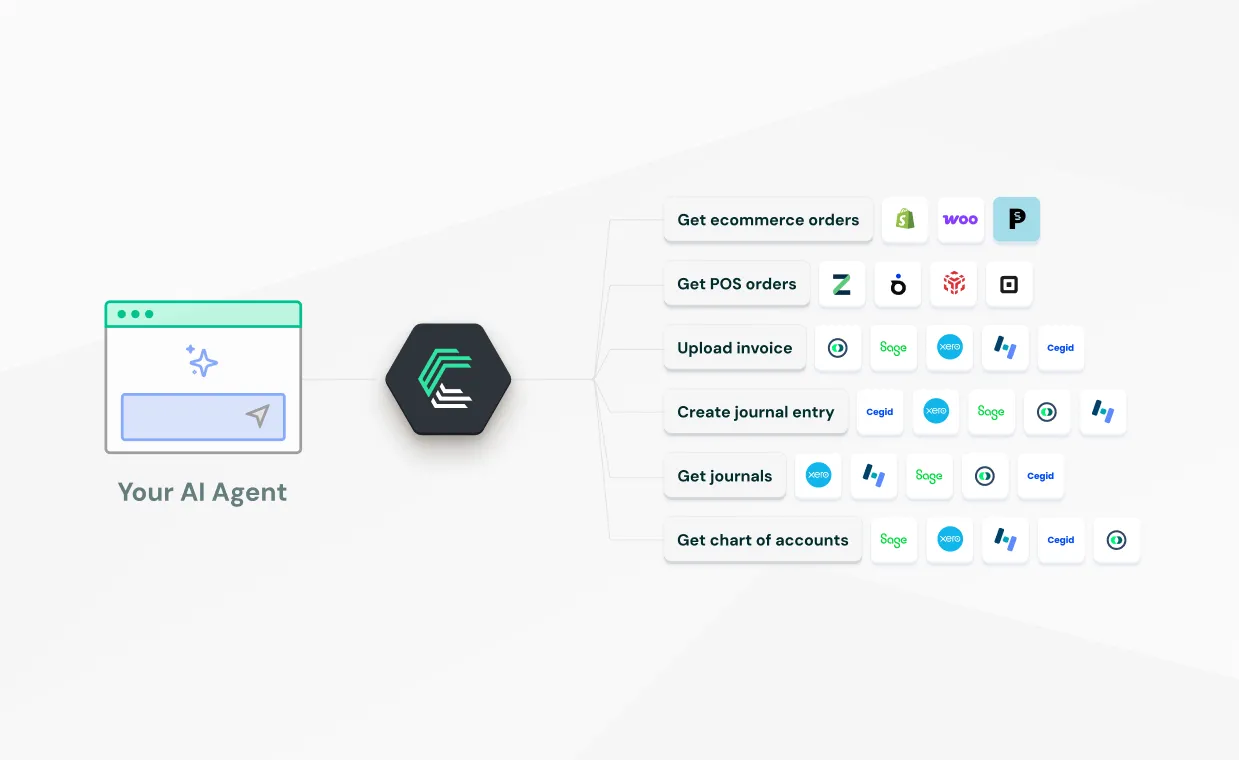
Le serveur MCP (Model Context Protocol) de Chift expose un ensemble d'outils qui reflètent notre API Unifiée. Il permet à un agent IA de déclencher différents workflows à partir des données financières de l'entreprise :
- importer vos ventes depuis votre caisse vers vos écritures comptables ;
- repérer vos factures les plus anciennes et vous envoyer une alerte sur Slack chaque lundi ;
- rédiger un e-mail à partir des données de votre comptabilité.
Une API Unifiée pour les intégrations classiques
Pour les workflows qui n'exigent pas une autonomie complète de l'agent, Chift propose également une API REST reposant sur le même modèle de données unifié. Vous pouvez ainsi :
- démarrer avec des intégrations classiques ;
- ajouter progressivement des capacités agentiques ;
- combiner les deux approches selon la complexité du cas d'usage.
Choisir la plateforme adaptée à vos besoins
Pour évaluer une plateforme d'intégration pour agents IA dédiée aux workflows financiers, examinez les points suivants.
La couverture de votre écosystème cible
La plateforme prend-elle en charge les systèmes de comptabilité, de caisse et de paiement qu'utilisent vos clients ? Sur les marchés européens, assurez-vous d'une couverture solide des plateformes locales comme Pennylane, Sage ou Cegid, en plus des outils mondiaux comme Xero et QuickBooks.
L'expérience développeur
Vos équipes vont construire sur cette plateforme. Prenez en compte :
- la qualité de la documentation ;
- la facilité de la première intégration ;
- le délai pour ajouter de nouveaux connecteurs ;
- la réactivité du support.
L'avenir des intégrations financières sera agentique
Le passage des intégrations programmatiques aux workflows pilotés par des agents est déjà engagé. À mesure que les capacités de l'IA mûrissent, nous verrons apparaître :
- des opérations financières conversationnelles : les équipes finance décrivent leur besoin en langage naturel au lieu de configurer des intégrations ;
- des workflows qui s'optimisent seuls : des agents qui apprennent des schémas observés et améliorent les processus au fil du temps ;
- une intelligence financière proactive : des agents qui font remonter des analyses et recommandent des actions avant même qu'on le leur demande.
Construire cet avenir suppose une infrastructure pensée pour lui dès l'origine. Les plateformes d'intégration pour agents IA fournissent ce socle : elles absorbent la complexité des données financières multi-systèmes pour que les agents puissent se consacrer au raisonnement et à la décision.
Pour les produits SaaS qui visent les marchés européens ou les entreprises présentes à la fois sur des systèmes comptables continentaux et anglo-saxons, des plateformes spécialisées comme Chift apportent l'expertise métier et les capacités agentiques nécessaires pour bâtir des workflows financiers fiables et scalables à l'ère de l'IA.
Par où commencer
Si vous explorez les capacités agentiques pour votre produit financier :
- identifiez votre cas d'usage agentique à plus forte valeur : où un raisonnement autonome aurait-il le plus d'impact ?
- cartographiez les intégrations dont vous avez besoin : quels logiciels de comptabilité, de caisse ou de paiement vos clients utilisent-ils ?
- évaluez les capacités de la plateforme : l'infrastructure répond-elle à la fois à vos exigences techniques et métier ?
- démarrez par un pilote : validez le concept sur un workflow avant de passer à l'échelle.
Les équipes qui construisent la nouvelle génération de logiciels financiers placent les agents IA au cœur de leurs produits. La bonne plateforme d'intégration rend cela possible sans multiplier l'effort d'ingénierie à mesure que vous grandissez.
Envie de voir comment Chift peut alimenter vos agents IA ? Contactez notre équipe pour une démo.
FAQ
Quelle différence entre une API unifiée classique et une plateforme d'intégration pour agents IA ?
Les API unifiées classiques exposent des endpoints standardisés sur lesquels les développeurs écrivent du code. Les plateformes d'intégration pour agents IA y ajoutent des capacités pensées pour les agents : interfaces en langage naturel, raisonnement contextuel et accès sémantique aux données. Elles sont conçues pour que des systèmes d'IA interagissent avec elles, et pas seulement des développeurs humains.
Ai-je besoin d'une plateforme d'agents si je construis de simples intégrations ?
Pas nécessairement. Si votre cas d'usage se limite à une synchronisation de données entre deux systèmes, une API unifiée classique peut suffire. Les plateformes d'agents deviennent utiles lorsque vous avez besoin de raisonnement multi-systèmes, de gestion des exceptions ou de workflows qui s'adaptent au contexte.
Comment les plateformes d'agents gèrent-elles les erreurs et les cas limites ?
Les plateformes d'agents spécialisées intègrent des capacités de raisonnement capables de détecter les anomalies, d'appliquer des règles métier et de décider quand traiter une exception de façon autonome ou l'escalader à un humain. Elles fournissent aussi des journaux d'audit complets pour comprendre chaque décision prise par l'agent.
Les agents IA sont-ils assez fiables pour des workflows financiers ?
Oui, dès lors qu'ils reposent sur une infrastructure solide, avec une validation propre au domaine, des pistes d'audit et une supervision humaine sur les décisions à fort enjeu. La clé est d'utiliser des plateformes conçues pour l'exactitude financière plutôt que des frameworks d'IA génériques. La plupart des mises en production utilisent les agents pour la collecte et le traitement initial des données, avec une validation humaine avant exécution finale.
.webp)