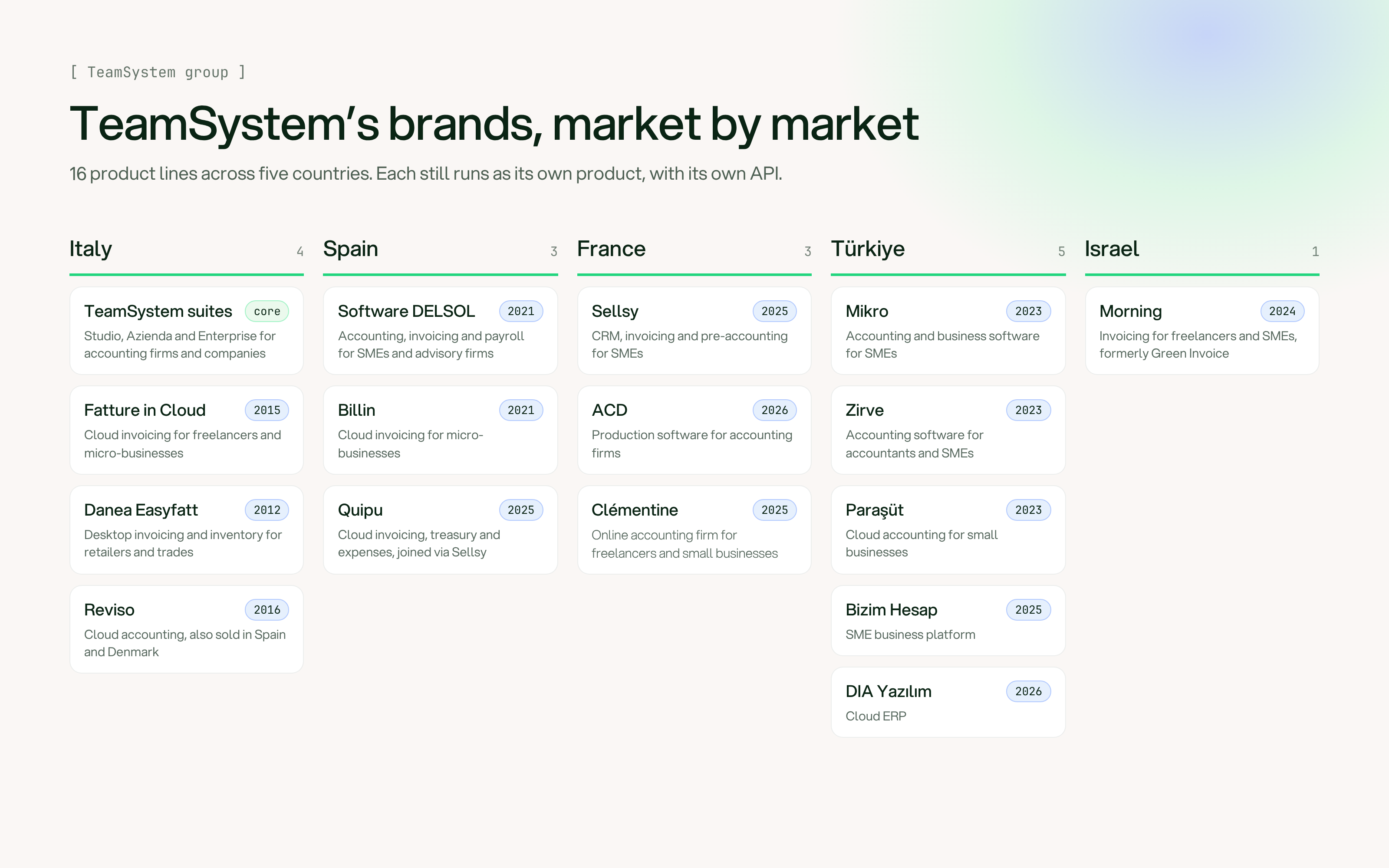
TeamSystem served more than 3.1 million companies and professionals at the end of 2025, and many of them have never seen the TeamSystem name on their screen. An Italian freelancer invoices in Fatture in Cloud. A Spanish SME runs Software DELSOL or Quipu. A French accounting firm works in ACD or Sellsy a Turkish shop owner in Paraşüt, an Israeli sole trader in Morning.
TeamSystem is an Italian business software group headquartered in Pesaro, founded in 1979, that sells accounting, invoicing, payroll, ERP and practice management software to SMEs, freelancers and accounting firms. It is the market leader in Italy and has been majority owned by the private equity firm Hellman & Friedman since 2016.
TeamSystem's 2025 results press release and FY2025 investor presentation, both published in April 2026, show its scale, with EBITDA, customer and headcount figures:
- Revenue: €1.15 billion pro forma, up 14% year on year and 12% organically
- Recurring revenue: about €1 billion of ARR, 88% of total revenue
- Adjusted EBITDA: €579 million pro forma, up 24%
- Customers: more than 3.1 million companies and professionals, up 20%
- Employees: more than 6,000
- International: 24% of revenue from outside Italy, with foreign revenue up 35% organically
Italy still generates about three quarters of revenue, but growth now comes from abroad. TeamSystem has a direct presence in five countries: Italy, Spain, France, Türkiye and Israel. Spain grew 24% in 2025, Israel 28%, and Türkiye 60%.
The shareholder base is also widening. In September 2026, press releases announced Francisco Partners would buy about 10% of the group and a group of investors including KKR around 5%, with Hellman & Friedman remaining the lead shareholder.
A group built through acquisitions
TeamSystem made 49 software acquisitions of control between 2015 and 2025 and 19 of them closed in 2023 to 2025. Revenue grew from €254 million in 2015 to more than €1 billion over the same decade.
The deals are concentrated in TeamSystem's core business:
- Accounting, ERP and invoicing: 17
- Industry, construction and property: 7
- Legal, compliance, and security: 5
- Other verticals: 20
Italy accounts for 36 of the 49 deals. Abroad, Spain counts 5, France 2, Türkiye 2 and Israel 1, but the three largest deals, each above €100 million, were all international and all closed from 2023 onward. In 2025 alone, TeamSystem spent €624 million on acquisitions, three quarters of it outside Italy.
Which brands does TeamSystem own?
TeamSystem’s portfolio is organized country by country. In Italy it sells its own TeamSystem-branded suites alongside the brands it acquired. In Spain, France, Türkiye and Israel it operates mainly through local companies it bought, which keep their names, increasingly with a TeamSystem prefix.
Italy: the home market
Italy is where TeamSystem started and where most of its brands sit. The core TeamSystem suites serve accounting firms (TeamSystem Studio) and companies of every size (TeamSystem Azienda and Enterprise). Around them, the group bought specialized brands such as Danea in 2012 and Fatture in Cloud in 2015, plus vertical players in legal software, construction, hospitality, fitness and wine.
Fatture in Cloud is the most visible of these. TeamSystem says it serves around 500,000 customers every year, and the brand recently adopted a new logo designed to sit closer to the TeamSystem identity. Danea Easyfatt is the desktop counterpart: installed software for retailers and tradespeople that relies on AGYO, TeamSystem's cloud e-invoicing platform, to send and receive invoices through SDI, Italy's mandatory e-invoicing exchange system.
Reviso: the e-conomic branch that went to TeamSystem
The e-conomic name appears in both the Visma and TeamSystem stories. In March 2016 TeamSystem bought 40% of e-conomic International, a separate Copenhagen company that sold e-conomic outside the Nordics, and took full control in June 2016. That company had about 2,500 clients in southern Europe, the UK and Germany. It was renamed Reviso. The Danish e-conomic, with its 250,000 customers, is a separate business owned by Visma. Some deal databases conflate the two, so check carefully when you see "e-conomic" attached to TeamSystem.
Spain: eight acquisitions since 2021
TeamSystem entered Spain in 2021 by buying 100% of Software DELSOL, a Jaén-based developer with more than 30,000 customers at the time, and a majority stake in the invoicing start-up Billin. Its Spanish site now lists Software Delsol, Aplifisa, Billin, Distrito K, Acumbamail, Asesor Excelente, Golden Soft and Quipu. Quipu came in through Sellsy, which had bought it in 2022 before joining TeamSystem in 2025, and counts as the group's eighth Spanish addition, and AIG Classic, an SME software firm with 34,000 users, followed in 2026.
France: one side for SMEs, one for accountants
TeamSystem's French business is built from four acquisitions now grouped as TeamSystem France: Clémentine (July 2024), the data analytics tool ClicData (July 2025), Sellsy (September 2025) and ACD (April 2026). Sellsy covers the SME side with CRM, invoicing, cash management and marketing, while ACD sells production software to accounting firms. Both are positioned for France's e-invoicing reform, which starts in September 2026.
Türkiye: everything runs through Mikrogrup
In 2023 TeamSystem agreed to buy 53% of Mikrogrup, whose Mikro, Zirve and Paraşüt product families served more than 150,000 Turkish businesses. It has since increased its stake to full ownership, according to Turkish press reports. Mikrogrup is also TeamSystem's acquisition vehicle in the country: it bought the SME platform Bizim Hesap and a minority stake in the fintech Nef Solution in November 2025, then the cloud ERP DIA Yazılım in April 2026.
Israel: Morning
TeamSystem entered Israel in December 2024 by buying Morning, previously known as Green Invoice, from Fortissimo Capital. The deal was reported at around $150 million. Morning serves about 150,000 customers, mainly freelancers and small businesses, and its founders stayed on to run the company.
Software for the business and for its accountant
In most of its markets, TeamSystem owns software on both sides of the accounting relationship: the tool the small business uses to invoice, and the tool its accounting firm uses to keep the books.
For an integration team, this changes who connects your product. In markets where an accounting firm keeps the books, the person authorising access may be the accountant working inside ACD or TeamSystem Studio, while the small business never logs in. ACD alone serves 3,200 firms that look after 1.3 million businesses. Check whether your target brand is used by the business owner, the accountant or both before you design onboarding.
How TeamSystem runs its brands
TeamSystem usually keeps acquired companies under their own names and management. When it bought Sellsy, it said the existing management team would keep leading the business, and Morning's founders also stayed in place. Fatture in Cloud is still sold as a separate product with its own website, pricing and developer portal.
None of these changes merges the underlying APIs. A customer may call their system "TeamSystem" while your integration talks to Fatture in Cloud, Reviso or Sellsy, so list each brand under both names in your connector catalogue and support docs.
Is there a single TeamSystem API?
No. TeamSystem has grown through acquisitions, and each brand has kept its own API, authentication model and access process. Some desktop products have no public API at all. As a result, an integration with Fatture in Cloud does nothing for a customer on Reviso, Sellsy or Paraşüt. Each product is a separate project to build and maintain.
Chift is built to unify this landscape. Through a single unified API, Chift connects your product to the TeamSystem brands it covers, alongside 150+ other financial tools across Europe. Authentication, data mapping and ongoing maintenance are handled for you, and the same connection gives AI agents access through Chift’s MCP. You integrate once and reach every TeamSystem customer you serve, whichever brand they use.
Brand by brand: what changes in your code
Fatture in Cloud has the most developer-friendly setup in the group. It runs a public REST API v2 with OAuth 2.0, official SDKs in eight languages, webhooks, an OpenAPI specification and an app store. Its quotas are layered: a short-term limit of 300 requests every 5 minutes, shared by every app connected to the same company, and long-term limits of 1,000 requests per hour and 40,000 per month. Exceeding the short-term limit returns HTTP 429, while exceeding the long-term ones returns HTTP 403, both with a Retry-After header. Only the long-term quotas can be raised on request.
Reviso still uses the token model it inherited from e-conomic. Your app holds an App Secret Token, and each customer generates an Agreement Grant Token by clicking an access link and approving your app. Both tokens go in headers on every call to rest.reviso.com. Grant tokens expire after 360 days, so plan a re-authorisation flow. A demo mode lets you explore the API with read-only requests before you sign up.
Sellsy offers a REST API v2 at api.sellsy.com/v2 with OAuth 2.0. Private API access only reaches your own Sellsy account, while public access, needed to connect other customers' accounts, has to be validated by Sellsy. Its older v1 API is a different, single-endpoint design, so make sure the documentation you follow is for v2.
Software DELSOL is installed software with an API you activate per company. You first create a developer account, which gives you a manufacturer code ("CodigoFabricante"). The customer then activates API access inside CONTASOL with that code, and Software DELSOL emails a customer code, database name and password for that company.
Paraşüt uses OAuth 2.0, but client credentials are issued by email through Paraşüt support rather than a self-service portal. Every request includes the company number in the URL (api.parasut.com/v4/{company_id}), and the documented rate limit is 10 requests per 10 seconds, low enough to shape how you design bulk syncs.
Morning issues API key pairs from its dashboard. You exchange the key ID and secret for a JWT and send it as a bearer token, and a separate sandbox environment is available for testing. Third-party documentation reports that API access depends on the customer's subscription plan, so confirm plan requirements before promising the integration to Israeli customers.
Quipu uses OAuth 2.0 client credentials and follows the JSON:API specification, so responses nest fields under attributes and require the application/vnd.api+json content type.
Which TeamSystem brands does Chift support?
Chift's Unified APIs put several TeamSystem brands behind one standardised integration, with authentication, pagination and rate limits handled on Chift's side:
- ACD, French software covered in Chift's Accounting API
- Contasol (Software DELSOL), Spanish software covered in Chift's Accounting API
TeamSystem brands also use Chift themselves. Sellsy and ACD rely on Chift's Unified Accounting API and Invoicing API respectively to let their users export invoices to MyUnisoft, Sage, Spendesk, Qonto, Pennylane, Agicap and many other tools. Read the full story: How Sellsy turned integrations into a strategic advantage with Chift.
✅ One integration for 150+ financial tools across Europe
✅ A standardised data model across accounting, invoicing, POS and e-commerce software
✅ Authentication, approval processes and rate limits handled for you
✅ An MCP server that exposes the same tools to your AI agents
✅ Strong coverage in Italy, Spain, France, Belgium, Germany and the Netherlands
Curious how Chift can cover the TeamSystem brands your customers use? Book a demo with our team.
Frequently asked questions
Does TeamSystem have a single API for all its products? No. Each TeamSystem brand, including Fatture in Cloud, Reviso, Sellsy, Paraşüt and Morning, runs its own API with its own authentication and access process.
Is Fatture in Cloud part of TeamSystem? Yes. TeamSystem acquired a majority stake in Fatture in Cloud in 2015. It is still sold as a separate product with its own developer portal at developers.fattureincloud.it.
Which countries does TeamSystem operate in? TeamSystem has a direct presence in Italy, Spain, France, Türkiye and Israel, with Reviso also serving customers elsewhere in Europe.