Belgium has required e-invoicing since January 2026. Italy has run on it since 2019. Poland, Spain and others are rolling out their own systems. Across Europe, mandatory e-invoicing is arriving country by country.
For a software vendor selling in several markets, this wave isn't one new standard to support. It's a growing number of sources and formats to read. Your customers bill from more and more tools, and each market expects its own statuses, in its own format.
We've extended our Invoicing API to take that part of the work off your plate. You keep the integration you already have: you retrieve invoices as structured JSON, you receive lifecycle statuses in the format each market expects, and the connector library keeps growing.
Here's what changed, and why we built it this way.
The shift is European, the implementation isn't
Every European country is moving toward mandatory e-invoicing, but no two are doing it the same way.
Some route invoices through a shared European network. Others centralise exchange through a public platform, or build their own national system. The timelines don't line up, and neither does the plumbing underneath.
For a vendor, that creates two very concrete effects.
The first is a volume effect. The mandate pushes companies that still invoice in Word or Excel to equip themselves, and they'll each pick very different tools depending on their trade. Those are the tools your product has to read.
The second is a change in nature. An invoice no longer arrives as a document to interpret. It arrives as structured data, with a status that changes over time.
An e-invoice has a lifecycle, and that lifecycle is data
This is the part most product teams discover late.
In a paper or PDF world, an invoice is sent, and then you wait. In an e-invoicing world, it's issued, transmitted, received, accepted or rejected, then paid. Each change of state is an event the network carries and the tax authorities track.
So your product has to answer a question that's simple to ask and painful to implement: where exactly is this invoice, right now?
These statuses travel in different formats depending on the market. Over the Peppol network, for example, they move as XML. The rules, the required states and the parties that issue them vary from one country to the next.
What we changed in the Invoicing API
You keep using the same Invoicing API, the same endpoints and the same data model. We extended it along three lines.
Lifecycle statuses, in the format each market expects. Our API returns statuses in the format each market uses, such as XML over Peppol. Each status is triggered by a real change of state and tied to the ID of the invoice it belongs to, so your product shows a reliable state, not an approximation.
Invoices as structured JSON. You retrieve every invoice in one clean, consistent structure, through the same endpoints as today. One schema to read, no parsing to maintain source by source, no rework when a local format evolves.
More connectors, invoicing and accounting. We keep widening the coverage of the tools your customers bill from. Accounting connectors will also become available in the Invoicing API, so you can handle both the business-to-business flow and the flow into accounting in one place. New connectors ship on the roadmap continuously.
Missing a connector? Tell us, and we'll look at adding it to the roadmap.
What this takes off your backlog
Interoperability is where the reform is won or lost
E-invoicing isn't just a format change. Its real value is that invoicing information now moves digitally, from one company to the next and from one tool to the next.
But that value depends on systems talking to each other beyond the strict regulatory perimeter. A company that receives compliant invoices in one tool, only to have them re-keyed by hand into another downstream, has ticked the legal box and lost the benefit of the reform.
That's exactly the role we play: connecting your product to as many invoicing, management and accounting tools as possible across Europe and beyond, so data flows end to end.
One integration, ready for e-invoicing
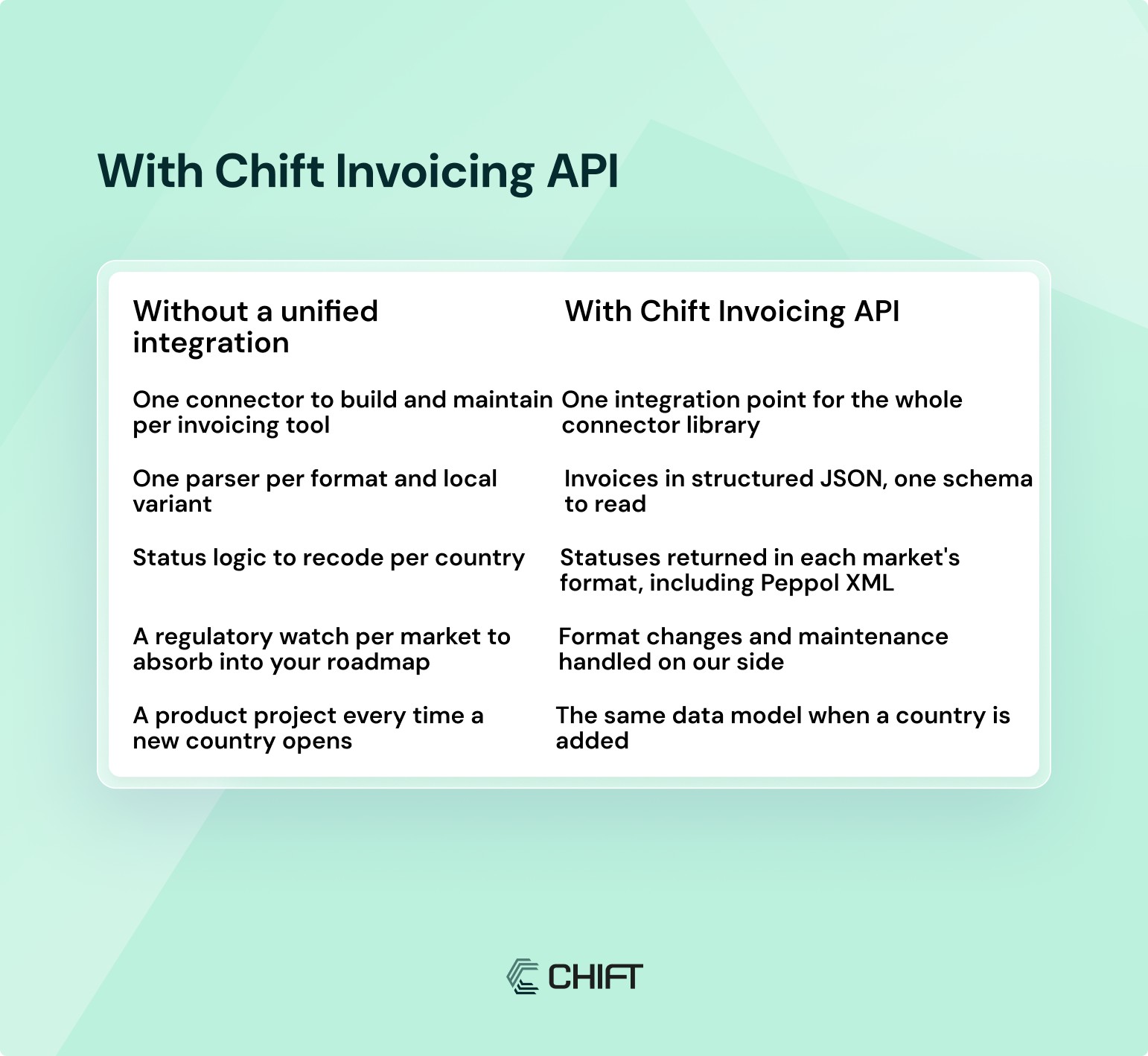
- Lifecycle statuses in the format each market expects, including Peppol XML, tied to each invoice
- Invoices retrieved as structured JSON, through the endpoints you already use
- A growing library of invoicing and accounting connectors
- A data model that stays the same when a new country is added
- Maintenance and format watch handled on our side
Want to see how the Invoicing API fits into your product as e-invoicing rolls out across Europe? Book a demo with our team.
.webp)